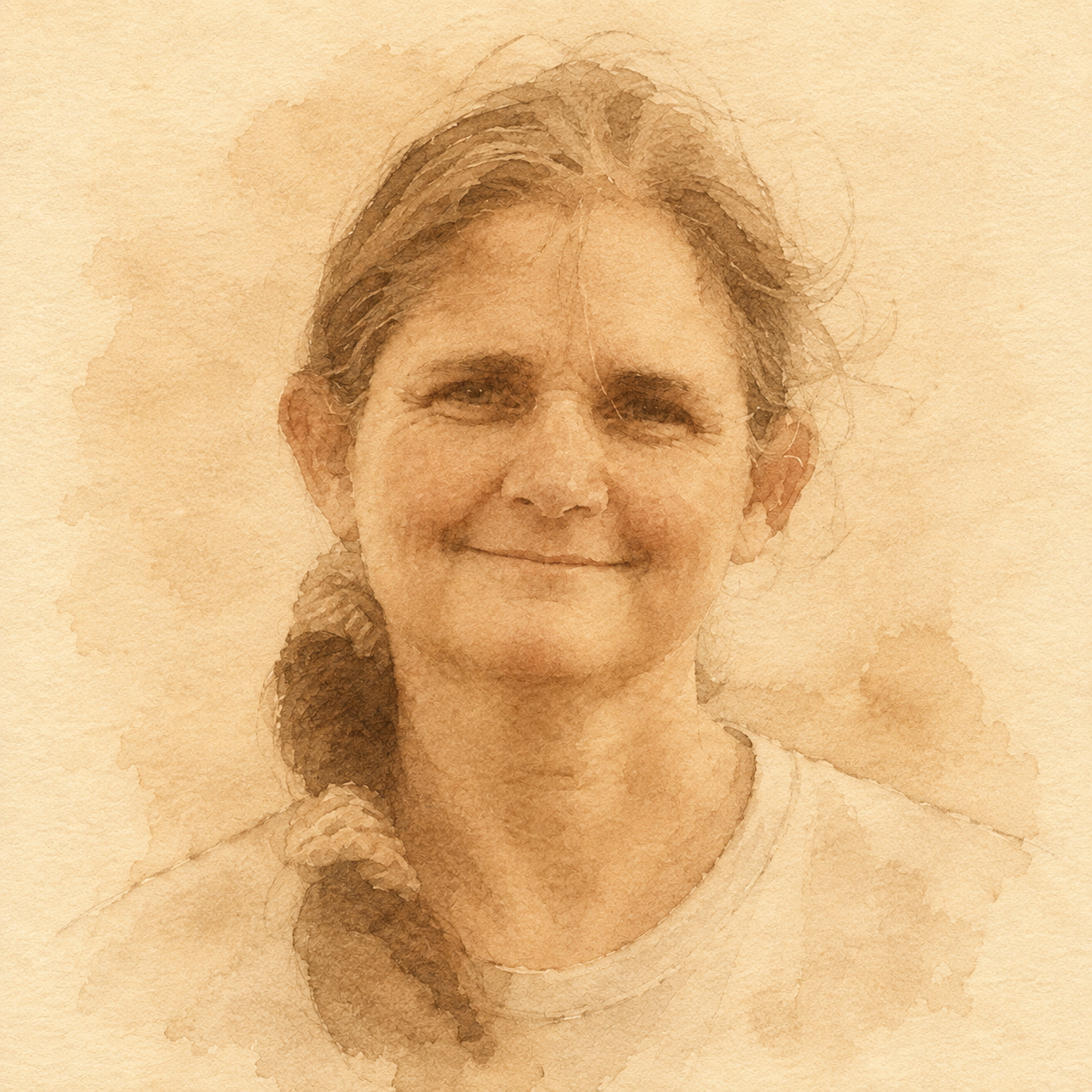
Trucker Angela Wood drove a covered wagon 4,500 miles coast to coast. A runaway in Asheville scalped her. Arkansas mud took a backhoe to escape. Then Starbuck, a rescue horse once starved to 250 pounds, carried her the last 175 miles into the Pacific.
Her advice: “If you wait for perfect, you’re never gonna do it.”
Click on the player to listen to Angela’s story.
Autogenerated transcript. May contain errors. Refer to the audio or video for accuracy.
Index
- Cold open: swallowed by Arkansas mud — (00:00)
- Meet Angela, Renegade, Starbuck and Shotzi — (01:13)
- A wagon three days old and the road east from Kentucky — (11:28)
- Logging trucks, Love Valley and the Atlantic at Sunset Beach — (22:24)
- Growing up wild in the mountains of Idaho — (30:16)
- A pot of beans and the cycle of poverty — (35:47)
- Bogged in Arkansas: the backhoe rescue and cattle guard gates — (47:09)
- The Oregon Trail, rattlesnakes and “If you wait for perfect” — (1:04:16)
- The Asheville runaway and the kindness of strangers — (1:38:29)
- Starbuck alone to the Pacific and the music of horse time — (1:57:19)
Angela Wood (00:00)
So I’m looking at this big mud puddle, it’s about twenty feet long, okay? And I’m looking at it going…
So I get out with a stick and I can’t find the bottom. I’m like, okay, I can’t pass through this. And then I see a little trail where it looked like a four-wheeler had gone around the side of it. And I’m like, okay, that’s a four-wheeler. My wagon should be able to make that.
All of a sudden I hear the most horrible noise in the world, a gurgle. You know, that mud-sucking gurgle?
There’s nothing I could do about it. All of a sudden the whole ground and everything that I was on just pushes me right down into the middle of that pond.
Buck somehow managed to keep to his feet, so he was still standing up, but Renegade was down. I mean, he was down.
And I look at my wagon and my Shotzi sitting in the wagon. And I’m like, I can tell I’m not gonna be able to move this, because when it went down the mud sucked up underneath it.
Bernie Harberts (00:54)
So it’s stuck.
Angela Wood (00:56)
It’s stuck. I mean, it’s stuck bad. It was stuck solid.
He says, you’re gonna need a backhoe to get this thing out.
Bernie Harberts (01:04)
Like an excavator backhoe?
Angela Wood (01:06)
Yeah, like an excavator backhoe. He said, you’re gonna need a backhoe to get your wagon out.
Bernie Harberts (01:11)
Oh my gosh.
Bernie Harberts (01:13)
This is my friend Angela Wood. She’s a long-haul trucker by trade and has an amazing story to tell.
But before we start, I want you to know that the audio at the beginning of this episode is pretty gritty for the first few minutes. But I left it in there because it fits who Angela truly is. She’s gritty and she’s fascinating. Here’s Angela describing where she’s sitting for this interview.
Angela Wood (01:40)
I’m actually in Sidney, Nebraska right now. So yeah, I’m out in the middle of nowhere.
Bernie Harberts (01:48)
Where are you sitting? What are you doing?
Angela Wood (01:52)
I drive for a company called ShipX and I’m driving to Utah to deliver a load. And right now I am sitting in my big rig in a little tiny truck stop in Sidney, Nebraska.
Bernie Harberts (02:04)
So what’s your big rig? Describe it.
Angela Wood (02:06)
It’s a Freightliner Cascadia, a 2025. I’ve got over 110,000 miles on it. And I put all but 5,000 miles on this truck in the last year.
When I’m fully loaded and I’ve got a good heavy load, I weigh 79,000, 79,500 pounds. Truck drivers like to say these big trucks are missiles rolling down the road.
Bernie Harberts (02:34)
That makes me nervous.
Angela Wood (02:37)
I mean, really, I hate to say how many times people have cut in front of my brake area when we’re coming up on a traffic jam. And I’m like, these trucks can’t stop. It takes a truck three football fields to stop from doing 55 miles an hour to zero.
So if you see a great big open spot in front of a truck, don’t take it. They need that stop.
Bernie Harberts (03:01)
By comparison, this truck fully loaded is 79,000 pounds. What did your wagon weigh and how long did it take to stop?
Angela Wood (03:11)
My wagon on a fully loaded day weighed 1,200 pounds. That’s with 36 gallons of water, two bales of hay and about 150 pounds of grain, plus the wagon, plus whatever I had in the wagon.
Bernie Harberts (03:32)
Yeah.
Angela Wood (03:33)
As far as stopping and going, it depends on how fast the horses wanted to stop.
Bernie Harberts (03:38)
Yeah.
Angela Wood (03:38)
I mean, some days they would stop so fast that the wagon would push up against them. Other days they’d just kind of ease it on down and be like, okay.
I guess on the usual day stopping probably took less than 100 feet.
Bernie Harberts (03:54)
How fast were you traveling?
Angela Wood (03:56)
I usually averaged about 3.5 miles an hour.
Bernie Harberts (03:59)
So let’s start by introducing your team, Starbuck and Renegade.
Angela Wood (04:05)
Renegade was my main riding horse. He was a 16-hand bay and white paint. He disliked people, he disliked working, he disliked everything in the world. But he was such a good horse. You point him at something and he goes. I mean, you ask him to do something and he was like, all right, do I have to? But I will do it. Excellent horse, even though he hated doing everything.
Bernie Harberts (04:32)
But he did it.
Angela Wood (04:34)
He did it. He never refused me. When I asked him to go through a creek, he went through the creek. If I asked him to go across a bridge, he would look at those joiners and he’d be like, I don’t know. I said, okay, come on, Reggie, let’s do it. And he would approach, he would touch it with his hoof and he would go on across, dragging Starbuck with him.
It didn’t matter whether Starbuck wanted to go or not, Renegade would drag him too, along with the wagon.
Bernie Harberts (05:01)
So Angela, describe that, because this is a really particular thing to horse and mule travel. Explain to people those expansion joints. They’re on the bridge. We all drive over them. It just makes that bump, bump, bump. But it scares the…
Angela Wood (05:17)
Yes.
Bernie Harberts (05:17)
…tar out of horses. Explain what that’s like for people.
Angela Wood (05:22)
The joints, because most of them have anywhere from a two- to four-inch crack in them, the horses in their mind walk up on this and it’s a Grand Canyon. They’re scared to death they’re gonna get their hooves caught in it. So most horses and mules and whatever other equine you want to ride, when they come up on these joiners, these expansion joints, it’s automatically a Grand Canyon. And if they’ve never had to cross them before, they’re gonna have a fit, they’re gonna stop, they’re gonna try not to go over it.
And that’s where my Renegade was such an awesome horse, because even though he had never seen one before, he walked up to it, he stopped, he looked at it and he put one hoof out and kind of touched the whole thing with his hoof. And he went on across. And he drove Starbuck and my wagon with him. But the main thing you had…
Bernie Harberts (06:09)
Wow.
Angela Wood (06:09)
…to understand about Renegade was he was nearsighted. He was half blind this whole trek.
Bernie Harberts (06:17)
Really?
Angela Wood (06:18)
Yeah. So for him, he always trusted me that it wasn’t going to kill him. And he would always check it out with his hoof before he would step on it. And then he would just go. I…
Bernie Harberts (06:30)
Wow.
Angela Wood (06:31)
…can’t explain how much Renegade, even though he was a high-strung horse and was nervous, how much he carried. I would say he was 60% of the team. He carried the whole trip. Without him, I don’t think it would have went as well.
Bernie Harberts (06:47)
Wow.
Angela Wood (06:48)
But on the other hand, Starbuck was a starved horse when we got him. He was a rescue. At four years old, he probably weighed in at about 250 pounds.
Bernie Harberts (07:02)
How much should he have weighed?
Angela Wood (07:04)
Well, on the trek he weighed 1,200 pounds.
Bernie Harberts (07:08)
Wow. And he was 250 when he was four years old.
Angela Wood (07:11)
Yeah, put it this way. When we went out to rescue him, well, I didn’t go out, but my friend went. She said when they got out there, he was laying on the ground, his head thrown back like he was already dead. They thought he was dead. And so they went up to him. They said, well, let’s check him. So they went up to him and he twitched an ear. Four women literally rolled this four-year-old, 15-hand horse over onto a tarp and picked that tarp up and carried him to the trailer.
Bernie Harberts (07:41)
Oh my gosh.
Angela Wood (07:41)
They carried a four-year-old, 15-hand horse to the trailer. That’s how skinny he was.
Bernie Harberts (07:47)
It’s like a skeleton carrying a skeleton on a tarp.
Angela Wood (07:49)
That’s all he was. He didn’t have anything. I mean, he was so skinny that his bones were trying to poke through his skin when he was laying. He had sores. You could almost see the bones through the sores on his skin. So he was a rescue.
Bernie Harberts (08:04)
So how long did it take you to get him back to health?
Angela Wood (08:09)
Okay, we got him back to the rescue. Then they put him in their little hospital pen, their little hospital stall. And it took them three days to find a harness to hold him up with, a sling to hold him up. And during those three days, they were turning him over side to side, trying to keep the sores from getting worse. And every 30 minutes, one of the volunteers would feed him a handful of food. A handful of food every 30 minutes, no more, because his intestines and everything else was shutting down.
Bernie Harberts (08:45)
Wow.
Angela Wood (08:46)
I mean, if he had been out there in that field for another three or four hours, he probably would have died. But because he was handled…
Bernie Harberts (08:51)
Right.
Angela Wood (08:54)
…so much and people rescued him, he loved people. Anybody could pet him, anybody could ride him, anybody could touch him. He was calm, quiet, but his nickname was Trouble, because he had this driving curiosity to find food.
Bernie Harberts (09:11)
I remember when you visited us, and I should just throw this in really quickly. You visited us on your way from Kentucky, and we’re gonna get into your route in a minute, on your way from Kentucky to the Atlantic Ocean. You rolled up the driveway with Renegade, Starbuck and Shotzi. And Starbuck was just a ham. Loved to stick his neck over the fence. Beautiful buckskin. And he did love to eat.
Angela Wood (09:41)
Because of his starvation, his one main drive in his life was to eat. If he lost an ounce of weight, he thought he was dying. That boy never refused anything on the trail. It didn’t matter what it was, he would eat it. If he got loose, all I had to do is find the nearest food and he would be there.
Bernie Harberts (10:02)
Be there. So introduce us to Shotzi.
Angela Wood (10:05)
She was a rescue from a kill shelter down in El Paso, Texas. She was 16 weeks old when I got her and she was already on death row. They’d already put her in the cages where they put the dogs that are going to be put down. They’d already moved her to them. They’d already signed…
Bernie Harberts (10:23)
Wow.
Angela Wood (10:24)
…her put-down paperwork.
I walked in looking for a 20-pound dog. I wanted a fully adult 20-pound dog that I could just take on the truck with me and not have to raise a puppy, not have to housebreak. You know how that goes.
Bernie Harberts (10:38)
Sure.
Angela Wood (10:40)
And when I walked in, she was laying on another dog, literally laying on top of this big old black dog that looked like it must have weighed 80 pounds. And she was three pounds at the time, just a little teeny tiny white dot. I didn’t realize it was a dog until she raised her head.
Bernie Harberts (10:55)
Wow.
Angela Wood (10:56)
She raised her head and looked up at me. She stood up on this dog, stretched forward, stretched back, you know how dogs do, hopped down off the dog…
Bernie Harberts (11:01)
Sure.
Angela Wood (11:03)
…walked over and looked up at me through the window. And I was like, okay, bring her out. And when she came out, there was me, my son and a couple other people who were adopting dogs in the room that they brought her to. And she immediately walked up to me, looked up at me and said, you’re mine. She adopted me, I didn’t adopt her.
Every time I moved, she moved. She said, I’m yours.
Bernie Harberts (11:28)
So let’s move into the wagon voyage itself. Just outline where did you start, where did you end, where did you go, how long were you out and roughly how many miles? Just a big overview to start with.
Angela Wood (11:48)
I was planning the trek two years before I actually went on the trek. I started studying, I started reading, I contacted you, I contacted Nick Buck. I tried to contact Rinker Buck, but he never responded back. I contacted anybody and everybody. I contacted the Long Riders’ Guild. I contacted everybody I could think of that had been on a horse trek.
And then when I finally started, I got my wagon three days before I started my trek.
Bernie Harberts (12:17)
No kidding.
Angela Wood (12:19)
What I was doing, I took two months off before I started my trek and I was riding them, trying to get them in shape, because none of us were in any type of shape to do this trek. We were all fat and sassy, put it that way.
And so I contacted Noah Slabaugh to build my wagon. And I was very particular. I wanted a wagon that would not rot. So my wagon was actually made out of marine plywood, one-inch marine plywood for the floor. And the sides of my wagon were cypress. And the canvas over the top was Iron Horse canvas. So…
Bernie Harberts (13:06)
Wow.
Angela Wood (13:08)
…you could put that wagon out in the rain for three years and you could still get in it and drive it if the tires didn’t rot. But…
Bernie Harberts (13:15)
Right.
Angela Wood (13:18)
…as I was waiting for him to build the wagon and I was training my horses to picket, to hobble, to highline, all this type of stuff, I also contacted a neighbor of Noah’s that had a harness for sale.
Now you gotta understand, I’d never harnessed a horse up in a work harness. I’d never harnessed a horse up before except my little pony with a breast collar. So I went down and talked to Eli, bought the harness, and then I asked him, I said, look, my horses have never pulled a wagon. They’ve never been a team. They’ve always been rogues. I said, can you show me how to harness them up? So he showed me how to put this work harness on my boys. And they were pretty calm about it. And then I said, can I pay you to hook them up to your wagon and take them down the road? He said, sure. So my horses had been drove three times by me and Eli before we hooked them…
Bernie Harberts (14:24)
And took off. Oh my goodness, Angela.
Angela Wood (14:26)
…up to the brand new wagon. Three times. And at that point, it was so funny, because when I got called and they said my wagon is ready, I put the harnesses on and I ground drove them up to where the wagon was, because it’s only like a half mile away.
Bernie Harberts (14:42)
Yeah.
Angela Wood (14:42)
And he had the wagon ready, but it was facing the barn. And I’m like, I’m not going to have my boys try to turn this wagon around when they’ve only pulled three times.
So I turned the wagon around and we hooked the horses up…
Bernie Harberts (14:54)
I’m just kinda gobsmacked.
Angela Wood (14:58)
…and I said, Noah, can you hold their heads while I climb in? So I climbed up in my wagon. I said, okay, turn them loose. I do believe the only thing that saved me on that whole start-off was neither one of them spooked at the same time. When one spooked, the other one would hold. So I drove it down to get the tarp put…
Bernie Harberts (15:17)
Wow! Wow, Angela!
Angela Wood (15:22)
…on it. And then I drove it back to the house, and my plan was for the next month to drive around the house, drive around the roads around the house, to get them trained to pull the wagon.
Bernie Harberts (15:37)
Sure.
Angela Wood (15:39)
Well, that night I got this wild hair. I said, you know, I can drive eight, 10 miles for the next month around the house, round and round in circles, just come back every night and sit here. Or I can just drive down the road for eight miles and stop and then do the next…
Bernie Harberts (15:55)
I love it.
Angela Wood (15:56)
…one. So three days after I got the wagon, me and my horses just started our trek. For the first week, I drove eight miles. For the second week, I drove 10 miles. For the third week, I drove 12 to 15 miles, and I just kept increasing that way to where towards the end of the six weeks I was doing 20 miles a day, approximately. Of course, that depended on weather, that depended on how the horses felt. I didn’t insist on 20 miles a day. That was just my plan.
Bernie Harberts (16:25)
So let me ask you here, because this is fascinating. This is really interesting, Angela. And then we’re gonna pick up the trip again. But one of the things I’ve found, and it’s always a challenge when I set off, is in the first, let’s say, month, until a horse or a mule has got some calluses under where the collar goes, maybe where the girth goes on a horse if it’s saddled, it’s really easy to get a gall, like a saddle sore. How many of those did you have, or were you able to avoid that by starting slowly?
Angela Wood (17:04)
The first month it wasn’t too bad. By the second month, Starbuck got a small sore on his upper neck. And I started asking around for people who knew harnesses, people who knew collars. I was thinking maybe the collar was not fitting right, even though it did fit right when I started. Finally, an old teamster from Bellatons, Tennessee showed up and he was like, the collars aren’t fitting quite right anymore because the horses have changed shape. See, I expected them to lose weight because of the trek. So I got the collars that fit perfect, but that could be shortened, you know, tightened down a little more. Well, what happened was their necks grew thicker and the collars weren’t fitting anymore. Because I was feeding a lot of food, they were building muscle instead of losing.
I had to buy another set of collars, and that set of collars worked really good. The sores went away. Everything went good for months, until we got out in Oklahoma and those collars started causing sores.
Bernie Harberts (18:26)
So you leave Kentucky and you’re heading east…
Angela Wood (18:30)
It is.
Bernie Harberts (18:31)
…towards what? What were you heading for?
Angela Wood (18:34)
My whole goal for the trek was I was going to go all the way to the East Coast. And that was my break-in period. I wasn’t going to push it. I wasn’t going for any type of speed thing. The trip from Liberty, Kentucky to the East Coast was just going to be kind of a wander-around, go-on-down type…
Bernie Harberts (18:53)
Okay.
Angela Wood (18:54)
…of thing. I wasn’t pushing for speed, wasn’t pushing for distance, and I really didn’t have an exact location. The only exact location I had was my sister lives in Salisbury, North Carolina. And I was going to stop by and say hi to her. So that was the only location I actually had down there. So I just kind of wandered around a little bit. My trail probably looked like a snake. You know, zigzag and…
Bernie Harberts (19:19)
I love that.
Angela Wood (19:20)
Because I’d be driving along and I’d be talking to the people and I’d be like, hey dude, where’s a good dirt road? Where’s a good road that doesn’t have any cars on it? Where’s the safest place for me and my wagon to go?
Bernie Harberts (19:32)
That’s right.
Angela Wood (19:33)
And so they’d say, okay, head towards this and there’s this road over here and you can take it. Well, I’d head kind of northeast. And then the next guy down the road would be like, yeah, okay, you can continue down…
Bernie Harberts (19:43)
Mm.
Angela Wood (19:43)
…here. But then if you take this road up here, go to there. So even though I used a GPS to keep track of my…
Bernie Harberts (19:51)
Yeah.
Angela Wood (19:51)
…miles, I used a GPS to keep kind of a sort of direction I wanted to go, I didn’t actually have a destination for the coast.
Bernie Harberts (20:02)
That’s beautiful. Wow.
Angela Wood (20:03)
I mean, I was kind of heading towards the Emerald Isle area, because that’s where you went. Yeah. So, you know, in your book, that’s where you went. So I was like, well, let me go on down there.
Bernie Harberts (20:11)
Why, I’m honored.
Angela Wood (20:16)
Because obviously they allowed a mule. I was going to say they’d allow me. But because of the storm, Hurricane Helene came through. When I was in Love Valley, I was only like 25 miles from my sister’s.
Bernie Harberts (20:34)
That’s right.
Angela Wood (20:34)
And it was coming through and I knew I couldn’t make it before it came through really bad. So yes, I got a lift from Love Valley to my sister’s house, because they had a great big barn and a great big pasture where my horses would be safe from the storm instead of sitting in somebody’s front yard.
Bernie Harberts (20:50)
So describe Love Valley for people.
Angela Wood (20:54)
Love Valley was awesome. It was so much like driving back into the 1800s. Dirt road, wooden buildings, the wooden walkways. It felt like just going into an old western. And…
Bernie Harberts (21:12)
Yeah.
Angela Wood (21:13)
…there were horses tied up alongside and it was just like, wow, you know? And the fact that they encouraged it, and that’s what it’s set up for. The whole…
Bernie Harberts (21:23)
Exactly.
Angela Wood (21:24)
…valley is set up for horses. Cars are second.
Bernie Harberts (21:30)
I grew up close to that. It’s called the Cowboy Capital of the World, which is pretty cool.
Angela Wood (21:35)
Hahaha!
Bernie Harberts (21:36)
It’s in North Carolina. It’s a cowboy capital.
Angela Wood (21:38)
Yeah, yeah. I kind of showed up in the off-season timeframe, because you know, this was getting towards winter. I started in August. By the time I got to Love…
Bernie Harberts (21:48)
Oh wow.
Angela Wood (21:49)
…Valley, it was almost October.
Bernie Harberts (21:52)
You’re moving into cold weather then. Man.
Angela Wood (21:55)
Yeah, well, that was my goal. See, the thing is, with what I was doing, I knew that I was going to run through the winter. The reason I started when I did is I wanted to get across the mountains during the heat of the summer. August is hot, September is hot in the East.
Bernie Harberts (22:11)
Now these are the Great Smoky Mountains, is that right?
Angela Wood (22:14)
Right. The Great Smoky Mountains. So I figured I’d go through the mountains during the heat of the summer and they’d stay cooler.
Bernie Harberts (22:24)
Describe for people what it’s like to drive a covered wagon down a mountain road with a guardrail on one side and the cliff on the other, and a logging truck coming up on you. What was it like?
Angela Wood (22:41)
Terrifying. Luckily my horses…
Bernie Harberts (22:44)
The scariest.
Angela Wood (22:45)
…were good with traffic. Here’s the image. Okay, you’re driving down this gravel dirt road and you look at it and it’s wide enough for two cars, barely. You know, in your mind you’re going, okay, there’s guardrail over there, my wagon is on the cliff side going down the hill, and you hear and feel the logging trucks coming in. You’re like, oh my. And you’re looking for a place to get off the road, because this road doesn’t seem to be wide enough. It is, but it doesn’t seem to be wide enough for the two of you.
Bernie Harberts (23:17)
Right.
Angela Wood (23:17)
There’s no place to get off. There’s no place to run to. So all you can do is take a deep breath. I always put my foot up on the front of the wagon, because I had a hand brake, not a foot brake. And I’d grab…
Bernie Harberts (23:32)
Wow.
Angela Wood (23:33)
…my reins. I’d lean forward and I’d grab my reins and I’d have one hand near the brake.
And I was always prepared that if the horses spooked, I would use my whole body weight back on the reins to hold them still. Then I would just pull over to the side and I would wait. I wouldn’t try to move. Me and my horses would just stand there while that truck went by. And then you’ve got the air pressure and the smell. When you’re on a wagon, the world is in your face. When you’re in a car, you’re blocked off. You don’t notice it. But in a wagon or on horseback, you smell, you hear, you feel, and your whole body just tightens up because you know what’s coming.
I’m a truck driver. I realize how much rocks and debris get thrown off those wheels, especially the log trucks where they’ve been driving in the mud. They’ve got rocks caked in their wheels and all that. And I was just so terrified of rocks being thrown off the wheels of those trucks and hitting my horses. Not…
Bernie Harberts (24:42)
Sure.
Angela Wood (24:42)
…so much me. For some odd reason I wasn’t worried about me, but I was worried about my horses being hit by these rocks.
Bernie Harberts (24:48)
Yeah. Did you ever get hit by stuff that came off vehicles or got thrown up?
Angela Wood (24:53)
Yeah. My Renegade, who was my outside horse, got hit several times. He got hit at least four or five times on the whole trek by rocks. And one time a piece of metal, it looked like a ball, came off and got him in the rib cage, and he actually had a cracked rib from that hitting him.
Bernie Harberts (25:17)
Wow. So let’s move ahead to the coast. You get to the Atlantic. You’re down in Emerald Isle, coast of North Carolina. And then…
Angela Wood (25:27)
Well, I actually didn’t make Emerald Isle.
Bernie Harberts (25:29)
Okay. What’s the closest you got to the Atlantic?
Angela Wood (25:31)
That’s where I was aiming for, but because of Hurricane Helene coming through, all the roads to Emerald Isle were blocked off. So I actually wound up at Sunset Beach, North Carolina.
Bernie Harberts (25:42)
Did…
Angela Wood (25:42)
And I got down there and I called the police, because there was a bridge going into Sunset Beach, North Carolina. So I got a police escort across that bridge, an escort to the beach. I didn’t actually take my horses onto the beach itself. I got them on the sand. But my horses had never been in the ocean. They’d never been around the ocean. And I wasn’t going to force them to go down there and have that panic attack. You know what I mean?
Bernie Harberts (26:09)
Good for you. Good for you. I think that’s great, Angela.
Angela Wood (26:11)
I just took them to the edge and let them look out over the ocean, and I was like, there’s the ocean. We made the East Coast.
Bernie Harberts (26:17)
And then what did it feel like to turn around and say, now we’re heading to the next thing? Did you know you wanted to go to the Pacific?
Angela Wood (26:27)
The whole plan was from the East Coast to the West Coast, from beach to beach. That was the whole plan.
Bernie Harberts (26:35)
You’re looking west and thinking, okay, now I’m going to the Pacific. What was that like?
Angela Wood (26:40)
Well, going from Liberty, Kentucky to the East Coast was just to break my horses in, get them trained, get them settled. Then when I got to the coast and I looked out at the ocean, I was like, wow, now it starts. I’m a fan of westerns. And I always liked that saying, go west, young man, and find yourself.
Well, that ain’t the exact saying, but you know what I mean. Go west, young man.
Bernie Harberts (27:05)
Sure.
Angela Wood (27:06)
And “see the elephant” is one of them. There’s a lot of different sayings like that.
And that’s what went through my mind. Go west, young man. And I was looking at my horses. I was like, go west, young boys. You know, and…
Bernie Harberts (27:16)
Yeah. Yeah.
Angela Wood (27:19)
…because I called my horses my boys, because that’s what they were. And so there was excitement there. There was history. How many thousands of people went from the East Coast all the way to the West Coast by horse and wagon, by horses, by mules, by ox cart, hauling carts by hand? So that was rolling through my mind, the sense of history, the sense of the excitement of following in our ancestors’ footsteps.
Bernie Harberts (27:48)
So what’s your favorite movie or book or saying about the West?
Angela Wood (27:58)
My favorite book, and it’s going to sound weird, is actually just a fiction book and it’s called Shy, S-H-Y. I read it when I was a child and I still read it. I still got the book. It was about a young boy, 12 years old. He was going west with his uncle and aunt who were, let’s face it, abusive towards him. And he wasn’t no angel. He got a kick out of setting them off. He was in a wagon train and he got captured by the Indians. And he grew up the rest of his time with the Indians. And it was really good, you know, the descriptions of the West, the mountains.
And my very first book I actually read about horse travel was the Abernathy brothers. They were five and eight years old. They rode across America at five and eight years old. By themselves. No adults. It’s actually a real story.
Bernie Harberts (29:01)
So you read these books early on. It was clear that this was inside you. Is that correct?
Angela Wood (29:07)
Yeah, yeah. I was 11 years old when I read the Abernathy brothers and my first instinct was to go out, get on my pony and go.
Bernie Harberts (29:16)
Tell me about your pony. Is this Sweet Love?
Angela Wood (29:19)
Yeah, this was Sweet Love. She was a little black and white Shetland pony, and at that time she was 18 years old. Most people think of a Shetland pony, they think of the biting, kicking, you know, abusive pony. Sweet Love wasn’t. Sweet Love was actually a really gentle pony. You could put a baby on her back, go for a five-mile ride, and she would bring the child back with her. Even if it fell asleep on her back, she would bring it back. She was an excellent pony, except if you could ride good enough to get her into a canter, she would dump your butt. And it wasn’t even a buck.
If you could ride good enough to get her into a canter, she would be cantering along and all she had to do was do a 180 and be going the other direction. You would hit the ground every time. She would dump me at least twice on every ride.
Bernie Harberts (30:16)
So tell me a little bit more about growing up. What did your parents do?
Angela Wood (30:24)
I grew up in the mountains of Idaho, up on the Canadian border. My stepfather, and all I’m gonna say about him is he was not a good man. He was a mill worker. He worked in a lumber mill. My mom basically didn’t work. I mean, she was a cook, but once she married Kurt, he didn’t want her working, so she stayed on the farm. We hauled hay, we hauled wood, we hauled water, because we didn’t have water on the property. We had to go down to an artesian spring and fill up a 500-gallon tank and bring it back on the back of the truck. The farm I grew up on, you could basically take it and put it back in the 1800s, and except for the truck and the chainsaw it would have fit right in.
Bernie Harberts (31:11)
So what was the best thing about growing up that way?
Angela Wood (31:15)
I grew up wild. What I mean by that is we had horses, of course. My job was to take care of the horses and take care of the rabbits. My sister’s was the cows and the pigs. My other sister was the house. She took care of the house mainly. My mom of course did everything.
So I would be getting on my pony first thing in the morning. I’d take all the horses, which was anywhere from 10 to 30 of them at a time, because that’s one of the side jobs Kurt did. He was a horse trader. And my job was to take the horses out to the back pastures up in the mountains and graze them and then bring them back at night. So I grew up in the wild. I mean, bears, cougars, I seen it all.
I was six years old the first time I was put on a pony, which was Sweet Love. And my training was he picked me up, he put me on her back and slapped her on the butt. Of course I fell right off. I didn’t have a clue. Didn’t have a clue how to stop her, didn’t have a clue how to control her. By the time three or four weeks had passed, I was riding like a wild Indian. Bareback, no saddle, rope around my pony’s nose, because I was losing the bridle, so I could just put a rope around her nose like the Indians did, you know?
Bernie Harberts (32:35)
Yeah.
Angela Wood (32:36)
I was training horses by the time I was seven years old. Kurt would bring in unbroke, untrained horses, horses that had tried to kill their riders, horses that were runaways, you name it. He would bring them in and he would tell me and my sister Tammy to break these horses. Then he would sell them as kid-broke horses.
Bernie Harberts (32:54)
So what was the worst thing about growing up that way?
Angela Wood (32:59)
You know, my stepfather, he was abusive. And I was home taught, so we didn’t go to public school. So we’d work all day hauling wood, hauling hay, hauling water, training horses, taking the horses out to the back pastures. We’d work all day. And then at night we’d have kerosene lamps and Coleman lanterns, and we would have to do schoolwork for four or five hours, because Mom was insistent we got our schooling. So we did homework at night and worked all day. I mean, we were doing 12-, 16-hour days as seven-, eight- and nine-year-old children.
Bernie Harberts (33:40)
That’s amazing, Angela. I never knew this about you.
What was the number one thing, good, bad, indifferent, that influenced you from the way that you grew up?
Angela Wood (33:53)
Growing up in that type of situation, where you actually grow up wild, with no other influences, no other people around, the number one influence on me was the love of the wilderness, the love of isolation, riding along as a child and seeing a flower. It’s hard to describe the feeling. You know what I mean?
Like I said, where I grew up and the way I grew up, you could put me back in the 1800s. We didn’t have a phone, we didn’t have a TV, we didn’t have any of that. Our running water was grab two five-gallon buckets, run out to the well, wheel the water up, pour it into the bucket and run it back to the house, put it on a wood stove to heat the water up.
Bernie Harberts (34:46)
So wagon travel kinda came easily. It’s a natural progression.
Angela Wood (34:50)
Yeah. Exactly.
Bernie Harberts (34:52)
So let’s just move ahead from North Carolina. You’re heading out. We can’t hit every state, clearly, but you’re heading to the Pacific. What was the toughest thing in that next phase? Let’s not cross the Rockies yet, but between the Atlantic Ocean and the Rockies, what was that like as the country changed, for example, to being out west?
Angela Wood (35:20)
On the Eastern Seaboard, people were… you probably know this too. You’d ask five or six people, can I park in your backyard? And people were standoffish. You’d get one out of every four people that would say, yeah, go ahead. A lot of knocking on doors. And I got a lot of “don’t want your kind here,” and I could never figure out what kind that was.
Bernie Harberts (35:47)
Yeah. So I’ve got a question on that subject. Pretend that you’re driving up to my house.
Angela Wood (35:56)
Uh-huh.
Bernie Harberts (35:56)
My wife’s at the house. You don’t know who we are. Give me your pitch. What did you tell people? Describe what you did with the team. Did you tie them up? Did you shout from the wagon? Just walk me through. You’re going up the road. It’s time to knock off. How did you go up to a house?
Angela Wood (36:15)
Well, first I’d assess the house. I’d look at it and go, okay, does it have a big backyard? Do they have a pasture? Do they have a place where I could put my horses? And if all those were yeses, then I looked at the house, and if it was a really rich house, 90% of the time I wouldn’t approach it, because they always said no. Not always, but most of the time the higher-priced places were less inclined to allow me in.
Bernie Harberts (36:42)
Interesting.
Angela Wood (36:44)
But I would go in and I’d approach and then I’d stop, and a lot of times I’d yell, hey, anybody home? But if nobody answered and I could tell they were home because their cars were there or something, I’d hop down and I would hobble my horses. Because I very seldom liked tying them up to something, because I was always scared that one would go left and one would go right and you’d have a problem with that. So I would usually hobble, because my horses were trained not to walk in the hobbles.
Bernie Harberts (37:13)
Okay.
Angela Wood (37:13)
When I was training them, I trained them not to walk in hobbles.
Bernie Harberts (37:18)
So to hobble them, it was in effect just a strap that went between the two front legs with a little short length…
Angela Wood (37:24)
Exactly.
Bernie Harberts (37:25)
…of something between, so they couldn’t make a long stride. Does that sound right?
Angela Wood (37:28)
Exactly.
Bernie Harberts (37:29)
And then what?
Angela Wood (37:31)
Then I’d walk up and I’d knock on the door. And whoever would answer the door, I’d say ma’am or sir, depending on who they were. I said, I’m driving my horses and wagon across country, heading for the West Coast to raise awareness of childhood hunger. And I need a place to stay for the night. Can I park my horses in your pasture, backyard, so forth and so on?
A lot of times I’d get a no, or a lot of times I’d get a yes, and then they’d be asking questions and looking at my horses and “can I pet your horses,” and just really excited about the whole situation. And most of the time, if they didn’t have a pasture, they would take me around to a nice wide open area and I would unhitch the horses and picket line them out. A picket line is one hobble around one foot, and it leads out to a stake that you pound into the ground. I had two picket lines. I’d picket line each horse, usually one on each side of the wagon so that there was more room. Because I had 14-foot picket lines, which meant I needed a 28-foot circle to picket line them out, so they don’t tangle each other up.
And then 90% of the time they’d invite me into the house to take a shower, to eat dinner with them. I remember this one family. I had just finished putting my horses on the lines. I was all done. I was getting ready to start my nightly ritual, because they hadn’t invited me in. And then this little six-year-old girl came walking up. She was so cute. Black hair, blue eyes, absolutely adorable. And she goes, and you could tell she practiced this with her mommy, “Mommy says you’re invited for dinner. Will you come eat?” And I was like, yes. So we went in and I walked into this home, very basic home, and the only thing on the table was a pot of beans.
No meat, no vegetables, just this pot of beans. And I sat down, they said grace. I don’t consider myself religious, but when somebody says grace, I bow my head and hold my hands and I thank the universe. And the father dished food out to me first, then the children, then his wife and then himself. And I’m like, these guys had nothing. Yet they still invited a stranger into their home to eat.
Bernie Harberts (40:11)
Wow.
Angela Wood (40:12)
And I looked around and there was barely food. There was rice and there was beans. And there was oatmeal for breakfast. That was it.
Bernie Harberts (40:22)
And yet that was enough for you.
Angela Wood (40:24)
They invited me in to eat with them.
Bernie Harberts (40:27)
Wow.
Angela Wood (40:28)
You know, I was just like, this is why I was out there, to help people like this who just don’t have anything. Yet people seem to think they should move to another place to get a good job. They should do this, they should do that. And the problem is moving takes money. If you don’t have the money to move to another place that has better jobs, how are you gonna get a better job? They’re caught in this vicious cycle. There’s no jobs in their area. So they have to move to get a job, but they can’t afford to move, because if you’re gonna move you’re gonna have to get rent saved up. You gotta do this, you gotta do that. It’s a vicious cycle for the poor folks, and especially in the Appalachians.
Bernie Harberts (41:11)
What would you say the number one thing is that you learned about the cycle on your trip that other people just don’t know?
Angela Wood (41:25)
It’s the cost of living. These people are living in a poor area, they don’t have any money, and people say, well, why don’t they just move to a place where they can get a better job? But you can’t. Everybody thinks that, hey, those of us who are better off can just move to another area and get a better job. It don’t work that way for the poor, the real poor. It doesn’t work that way. If they’ve got a roof over their head where they’re at, but they’re barely making it, just barely putting food on the table, how are they gonna save up enough money to move to a better place where they can get a better job?
Bernie Harberts (42:05)
Because those places are more expensive. The more jobs pay, typically it scales to the price of lodging and food. And…
Angela Wood (42:13)
Exactly.
Bernie Harberts (42:15)
…that’s a really important message.
And so, just moving ahead a little bit, you’re getting out west now. What was that feeling when you first finally reached the wide open, and I see you grinning already, the wide…
Angela Wood (42:32)
Yeah.
Bernie Harberts (42:32)
…open roads with no logging trucks coming down gravel roads with guardrails? What was that feeling like?
Angela Wood (42:41)
Freedom.
It hit me right after I got across the Mississippi into Arkansas. Once I got away from Florida and I started hitting dirt roads consistently and constantly. Little dirt roads where there aren’t the trucks and there aren’t the big rigs. Sometimes you’d run across a pickup truck. Maybe only two or three pickup trucks in a day on these little back roads. I stuck to the back roads. I didn’t go near the big roads.
It was just awesome. I mean, you’re driving along and you’re no longer hearing traffic and you’re no longer hearing the sounds of civilization, even though you’re on a gravel road.
Bernie Harberts (43:17)
Yeah.
So how did you get across the Mississippi? Because there are not many small bridges and it’s a big river.
Angela Wood (43:29)
I knew that was coming up, and the route I decided to take actually took me through Memphis, Tennessee and West Memphis, Arkansas, okay? I went across that big bridge. But the thing was, I knew it was coming up and I had made arrangements with this really kind young gentleman named Clayton. He said, when you get to Memphis, Tennessee, give me a call and I’ll bring my horse trailer down and we will travel you across the Mississippi bridge.
So I managed to make it to the Memphis Agricultural Center, who kindly put me up, and he came down the next morning. We loaded the horses on and we tied my wagon onto the back of his horse trailer. Now the thing about a wagon with a long tongue…
Bernie Harberts (44:16)
Wait, stop, stop, stop. Angela, stop. You tied it to the back of the horse trailer. You towed it behind the trailer. Okay, start again. I wanna hear this. This is crazy.
Angela Wood (44:25)
Exactly. We tied it to the back of the horse trailer and we took off, and as soon as it got to about 30 miles an hour my wagon started going left and right, because I had a long tongue on it. So…
Bernie Harberts (44:38)
Oh, sure.
Angela Wood (44:41)
…I had a good frame underneath and I wasn’t worried about going 60 miles an hour with my wagon, because it was that solid-built wagon. But every time we got the speed up it started doing this zigzag back there. And we’re on the interstate. Interstate 40 with this thing.
Bernie Harberts (45:00)
I’ve been across that bridge. It’s terrifying.
Angela Wood (45:02)
He went 35 to 40 miles an hour, creeping across this bridge with traffic going every which way. You know how traffic is. But luckily we only had to go about another mile on the other side, where I knew Pascal Truck Lines had agreed to let me get out and harness up and all that that night.
Bernie Harberts (45:23)
West Memphis. That’s the same way I went across on my first saddle trip across the country. That is a massive bridge, Angela. To tow a wagon across seems nuts.
Angela Wood (45:35)
Even having my horses on a trailer…
Bernie Harberts (45:38)
I know.
Angela Wood (45:39)
…with the wagon acting up back there, I was just terrified my wagon would hit a bump and jerk over and hit a car, be wrecked, you know? And Clayton and his friend were doing an excellent job of hauling me across this bridge. But yeah, it was stressful.
Bernie Harberts (45:56)
So they put you off in, I think if memory serves, it’s very close, West Memphis, close to a place called Crawfordsville, where I stayed with my mule and pony Woody and Maggie. And then you take off there. And what I want to hear is what are you starting to think about the season, crossing the Rockies next winter? What’s on your mind and what are you shooting for?
Angela Wood (46:22)
Well, at this point, when I went through Memphis, it was January. So it was the height of winter.
Bernie Harberts (46:28)
Jeez, my gosh.
Angela Wood (46:33)
When I went through Memphis it was the beginning of January, and so I hit the trails in Arkansas at the height of the rainy season. I got so tired of the rain. It seemed like it always drizzled.
And the roads were wet, but luckily most of the roads I was on were gravel, so I didn’t get the muddy incident until I was about three quarters of the way through. Once again, I tried to stick to the back roads. And so…
Bernie Harberts (47:01)
Yeah.
Angela Wood (47:01)
…every time I found a back road going in the direction I wanted to go, I took it. And that’s why I made so many miles, is ’cause I zigzagged a lot.
Bernie Harberts (47:09)
Tell me about the muddy incident.
Angela Wood (47:12)
I went through the national forest in Arkansas, and I knew the minute I got on this road I should have turned around, because there were puddles. And I know Arkansas has gumbo mud, a really slick clay mud. But I didn’t want to go back on the road I was on, because there was a lot of traffic on it. So I was like, I’m gonna do this. Well, I come up on this creek.
And I’m looking at this creek and I can’t see the floor. So I get out there with a stick and I’m poking the stick along. And it seemed to be solid. So I said, okay, Renegade, let’s go. And of course Renegade, being my big boy and my go horse, he steps off and goes on in. What I didn’t realize is that this was actually a paved crossing and there was a drop-off on the other side.
Bernie Harberts (48:07)
Oh no.
Angela Wood (48:07)
So I’m tooling along, everything’s going great, and all of a sudden Renegade just plumps right down in and starts swimming. And all I can think…
Bernie Harberts (48:15)
In the harness.
Angela Wood (48:16)
…of is that if my wagon goes off this, we’re tipping over. So I grab my rein and I pull as hard as I can on the rein to get him to go to the right. And Buck, bless his heart, that little powerhouse, he was the turbo on this trek. He put his head down and he pulled Renegade and my wagon back up onto the solid road. And all…
Bernie Harberts (48:43)
Wow.
Angela Wood (48:44)
…I could think of in that moment when that happened was my horses are gonna drown, my wagon’s gonna tip over. I didn’t care about myself, but my dog and I were gonna drown. It was just absolutely terrifying. And we get out the other side and I stop and I get out and I feed my horses apples and sweet potatoes, and all three of us are wet, cold and shaking.
Bernie Harberts (49:06)
Wow.
Angela Wood (49:08)
At that point I knew I should turn around, cross that back over and just go the other way. But I’d already gone six miles into this, and it was only two miles further on, I’d be back on paved highway. So I continued on, and the puddles start getting bigger and muddier and I run across this humongous mud puddle. It covered the whole road.
So I’m looking at this big mud puddle, it’s about twenty feet long, okay? And I’m looking at it going…
So I get out with a stick and I can’t find the bottom. I’m like, okay, I can’t pass through this. And then I see a little trail where it looked like a four-wheeler had gone around the side of it. And I’m like, okay, that’s a four-wheeler. My wagon should be able to make that. You know, I judged that I could make it. So I go, okay, come on, boys. My horses go up and we’re walking along. All of a sudden I hear the most horrible noise in the world, a gurgle. You know, that mud-sucking gurgle?
Bernie Harberts (50:07)
Yes.
Angela Wood (50:09)
And I’m like… There’s nothing I could do about it. All of a sudden the whole ground and everything that I was on just pushes me right down into the middle of that pond.
Buck somehow managed to keep to his feet, so he was still standing up, but Renegade was down. I mean, he was down. The water was covering him, but he was holding his head up, of course. He wasn’t drowning, but he was down. And the thing about Renegade is he got stuck in a mud puddle when he was a two-year-old. And as soon as he feels like he’s in a mud puddle, he freezes. He won’t move, he won’t get up, he won’t get down. He just freezes.
So I reach back real fast, grab my sleeping bag and my boots and put them up high, because I knew that if they got ruined, I was in trouble. Which I already was in trouble because of the puddle. And so I hop out. I forget to take my boots off. I hop out fully clothed. And I try to get Renegade up. Renegade won’t get up. So I unharness them both real quick and I lead Buck out, figuring if I get Buck out of the way, Renegade may decide he can move and get up. And of course, once I get Buck up and tied and I start walking back, Renegade hops up and plunges out. So I tie him up and I look at my wagon and my Shotzi sitting in the wagon. And I’m like, I can tell I’m not gonna be able to move this, because when it went down the mud sucked up underneath it.
Bernie Harberts (51:38)
So it’s stuck.
Angela Wood (51:39)
It’s stuck. I mean, it’s stuck bad. I’m like, okay. So I get back up in the wagon. It’s 40 degrees out. You gotta remember this is in January. It is cold. It is wet. I’m soaked from head to toe from getting Renegade out and Buck out. So I hop up in my wagon. Water is up to the bottom of the seat. So I’m standing up on my seat, all curled up in a little ball, shivering. I’m like, I gotta get dry. That was the thought in my mind. I gotta get dry.
Luckily I had my clothes up in bags high on my wagon, so my clothes were dry. So I grabbed clean clothes and I dry off and I change. I’m dry, I put my dry boots on, and I realized something. There’s five feet between me and the edge of the puddle of water. And it was about up to my waist.
Bernie Harberts (52:25)
Wow. Surrounded by water.
Angela Wood (52:29)
No way out. So I’m like, now what? So I’m sitting here shivering and I’m like, okay. So I take Shotzi and I pick her up and I gently toss her to the edge of the puddle. I strip down, put my clothes in a plastic bag, toss them to the edge of the puddle, and I hop out starkers and I walk through that mud, through that water, starkers, to get to my dry clothes.
Bernie Harberts (53:02)
Jeez.
Angela Wood (53:04)
I get out there and I’m shivering and I’m shaking, and I dry off and I get dressed and I start walking. I take my boys and I walk to the highway. But because I was so stressed, I left my phone. I left my wallet, ’cause I was so stressed out.
Bernie Harberts (53:20)
Sure.
Angela Wood (53:22)
So I walk up to the very first house I see. I knock on the door, and I remembered the name of my host that I was supposed to spend the night with. And the guy comes to the door. I said, look, I know this is gonna sound weird. I point to my horses so he can see I’m not something crazy. I said, my wagon got stuck back there in the national forest on the trail. I forgot my phone, I forgot my wallet. I need to call this guy. I said, do you know this guy? And luckily he knew the guy. He knew who…
Bernie Harberts (53:53)
Wow.
Angela Wood (53:54)
…’cause I was only like three miles from where my host was.
Bernie Harberts (53:56)
Yeah. Oh man.
Angela Wood (53:59)
So he calls him, he comes out with his horse trailer and he pulls a four-wheeler out, and he’s gonna go pull my wagon out with a four-wheeler. Well, that didn’t work. It was stuck solid.
Bernie Harberts (54:10)
Good Arkansas gumbo.
Angela Wood (54:12)
He says, you’re gonna need a backhoe to get this thing out.
Bernie Harberts (54:15)
Like an excavator backhoe?
Angela Wood (54:18)
Yeah, like an excavator backhoe. He said, you’re gonna need a backhoe to get your wagon out.
Bernie Harberts (54:22)
Oh my gosh.
Angela Wood (54:23)
And all I can think of is, I don’t have my wallet, I don’t have my money, I don’t have my phone. I was starting to spiral. You know how you spiral. And…
Bernie Harberts (54:30)
Yep.
Angela Wood (54:32)
…he said, we’ll work on it. I know somebody with a backhoe. So he takes me to a motel room, because he had a hang-up about having an unmarried woman in his house, ’cause he wasn’t married.
Bernie Harberts (54:46)
Sure, sure.
Angela Wood (54:48)
And I was like, I’m fine with that. I understand the mentality here. So he took me to a motel room, he paid for my motel room, he brought me dinner. He put my horses up on his ranch. Next…
Bernie Harberts (54:59)
Good guy.
Angela Wood (55:00)
…morning he comes and picks me up. He says, I’ve arranged it with the National Forest Service to allow a backhoe in, ’cause it was national forest. Motorized vehicles are not allowed there.
Bernie Harberts (55:13)
That’s right. Even a chainsaw sometimes. Whoa.
Angela Wood (55:17)
Right. But he managed to arrange it to where this guy could bring in the backhoe and pull my wagon out for me. But here was the kicker. He couldn’t go in that half a mile. He had to come back around the way I came in, through the creek, through the mud, through all that, to get to my wagon.
Bernie Harberts (55:36)
With this huge backhoe.
Angela Wood (55:38)
With this humongous backhoe. And…
Bernie Harberts (55:42)
Mm.
Angela Wood (55:43)
…of course this backhoe’s humongous. It’s tearing up the mud. It’s tearing up the ground because the ground is so soft. And he gets it in there, and…
Bernie Harberts (55:47)
Yes. That’s right.
Angela Wood (55:51)
…of course they brought a four-wheeler too, to pull the wagon out. ‘Cause the backhoe…
Bernie Harberts (55:54)
Right.
Angela Wood (55:55)
…of course wasn’t gonna be able to pull the wagon once he got it out of the mud.
Bernie Harberts (55:58)
Right.
Angela Wood (56:00)
So because coming in, the backhoe tore the land up so badly, going back out through that mud and that muck, we were covered from the top of our heads to the bottom of our feet in mud by the time we got my wagon out.
Bernie Harberts (56:15)
What a mess.
Angela Wood (56:16)
All my grain was ruined, all my hay was ruined. I had this much mud on the bottom of my wagon. My mattress was just a mud puddle.
Luckily my clothes and my sleeping bag were up high enough where they didn’t get wet. And there were times I thought for sure my wagon was just gonna disappear into this mud hole on the way out. So he gets me out, his friend grabs my horses and he takes me to Robbers Cave campground, a horse campground. He drops me off and I’m like, how much do I owe you for the backhoe, for all this?
He goes, y’all don’t owe me anything. They all said that and they left.
Bernie Harberts (57:02)
Amazing.
Angela Wood (57:03)
Yeah. And then I’m sitting there, and here’s one of the down parts of my whole trek. I’m sitting there soaked in mud. My horses were soaked in mud. I had no grain, I had no hay. Shotzi had started throwing up halfway through that whole rescue incident.
Everything was muddy, everything was dirty. I just wanted to sit down and cry. Really. But I looked at my horses, I looked at my puppy who was throwing up, and I was like, I can’t stop. So I walked up to the ranger station up there.
And I said, look, this is what happened. I need help. I need someone to take me to town to wash my clothes. I need someone to take me to town to get horse feed and grain and food for my dog. I said, I need help. And this angel in disguise said, when I get off work, we’ll come down and get you straightened out.
She took me to town, she waited while I did my laundry, she took me over to the Tractor Supply. She put hay in the back of her car.
Bernie Harberts (58:16)
Wow.
Angela Wood (58:17)
And got me everything I needed, and the next day I spent cleaning everything out. But Shotzi was still throwing up. So I put a message out on Facebook and in my blog, and I said, I need help. I need to take my dog to the vet. Does anybody know anybody around this area that would take me and my dog to the vet?
A lady I…
Bernie Harberts (58:45)
Yeah, yeah.
Angela Wood (58:47)
…stayed with a couple of weeks before in Hart Hunter, Arkansas, said, my daughter and her husband live there. I’ll call them.
She called him, he came out, took me and my dog to the vet. And they were so kind. Even when she threw up in their truck.
Bernie Harberts (59:05)
Oh, poor Shotzi. Yeah.
Angela Wood (59:08)
Come to find out, she must have ate something while she was running free while I was walking the horses out, and she had pancreatitis.
Bernie Harberts (59:16)
Good thing to catch, though, before you head out into the big open plains.
Angela Wood (59:20)
Exactly. So she was on medication for it and special foods and all this for almost a week before she got better.
So all this happened within a 24-hour period. It was just like, ooh, that was one of the lower spots in my trek. I’m doing this to myself.
Bernie Harberts (59:39)
Right. You could quit, but you can’t quit. One of those…
Angela Wood (59:43)
Exactly.
Bernie Harberts (59:44)
…things.
Angela Wood (59:45)
I mean, that’s the one thing I hated about the whole trek. My nemesis. Cattle guard gates.
Cattle guards are expanded metal across the dirt roads that stop cows from going through. They have cracks in them that catch the horses’ hooves. To go through the ones that have gates, you gotta open the gate, take your horses through and shut the gate. Now it sounds simple, but here’s how I would approach it. I’d see a cattle guard gate coming up. I would look and see how much the drop-off of the road is into the ditch. I had to figure out where I can get my horses and my wagon down into the ditches, and some of them ditches were pretty steep and deep. Then you get to the gate. I’d get out, I’d hobble my horses, open the gate, which then I got a gate jack, which helped a lot. Pull it open, lead your horses and wagon through, hobble them again, shut the gate, unhobble, get back in. And I always fed a snack at the same time, so I was always feeding snacks.
Bernie Harberts (1:00:52)
How long would that take?
Angela Wood (1:00:54)
It would usually take about 15 to 20 minutes each time. And that’s if I could get the horses down the hill…
Bernie Harberts (1:01:01)
Ooh.
Angela Wood (1:01:02)
…to the gate. Sometimes I had to turn around and go back a mile to get to an area where I could get down into the bottom and to the gate.
There was one time it was 14 gates in one day. Every mile, every two miles, there was a gate. It got to where I hated seeing a gate coming up.
And there was one time there was no way through. There was no gate on either side. The past turnoff was, well, not 20 miles back, probably more like 10 miles back, and there was no turnoffs, no ditch on both sides, no way through this gate. And I’m sitting there looking at it going, boy.
So then I got out and I walked up to it and looked at it, and it was half full of sand. And I’m like, hmm. So I was like, okay, I’m gonna do something very risky here. I pulled my wagon up as close as I could get to it, unhitched the boys, strung a rope across the spot that wasn’t covered in sand and put my coat across it so it looked like a jump.
And then I sent Renegade over it. And of course Renegade jumps right over it and I tie him up. No problem, right? I go back and I get Starbuck. Now remember, Starbuck’s nickname was Trouble for a reason. I lead him up to that and I say, okay, come on, Starbuck. He looks at it and trots right through the rope, steps on the freaking metal and trots right across it. Luckily, he did…
Bernie Harberts (1:02:33)
Oh no!
Angela Wood (1:02:34)
…not fall through. I’m like…
Bernie Harberts (1:02:37)
‘Cause you could break a leg.
Angela Wood (1:02:38)
Right. I’m like, you’re supposed to jump, horse. I made it a jump. And no, he just trots right through, drags my rope, drags…
Bernie Harberts (1:02:47)
Oh, geez.
Angela Wood (1:02:48)
…my coat, because I didn’t tie it tight, and just trots right on through. And I’m sitting there going…
Bernie Harberts (1:02:52)
Sure.
Angela Wood (1:02:53)
…praying. The minute I seen that he wasn’t jumping, I started going, oh my, my, don’t fall, don’t fall, don’t pick up your feet.
Bernie Harberts (1:02:58)
Oh no, no, no.
Angela Wood (1:03:00)
He managed to place his feet just right and trotted right on across.
And I managed to pull my wagon to where the tongue was across the cattle guard. Then I hitched him back up and finished pulling it across.
Bernie Harberts (1:03:12)
Amazing.
Angela Wood (1:03:13)
The stress of that moment, when I seen that he wasn’t gonna jump and it was too late to stop him from going, was horrendous. I sat there for like ten minutes after I got him harnessed back up. I sat in my seat and just shook. ‘Cause it was so easy for him to just put his foot down in there and break a leg. And it was my choice to ask him to…
Bernie Harberts (1:03:33)
Yep. Exactly. Oh no. Angela.
Angela Wood (1:03:37)
…cross it. It was my choice to ask him to cross it. Even though I set it up as a jump, it was still my choice. And I was just like, whoa, you know?
Bernie Harberts (1:03:49)
That can be a burden. Put a big weight on you.
Angela Wood (1:03:51)
Like I tell people, it was my choice to be out there, it was my choice to take my horses out there and it was my choice to take my dog out there. So any injury, any deaths, which there wasn’t none, thank God, would have been on my shoulders, because it was my choice. That’s something…
Bernie Harberts (1:04:09)
Yeah. Yeah. Yeah.
Angela Wood (1:04:13)
…you gotta think about before you do a trek like that.
Bernie Harberts (1:04:16)
I was a little bit behind you, riding my mules Brick and Cracker to Idaho. So I actually followed, and this was really cool, in your tracks. We actually stayed at the same places in some cases. And when I got to Independence Rock, Wyoming, they remembered you. So tell me about getting to Independence Rock, Wyoming. I imagine you crossed, I assume, Nebraska. You get to Wyoming, Independence Rock. What were you thinking about crossing the Rockies? Were you already starting to think, I gotta get there?
Angela Wood (1:04:55)
Yeah.
Bernie Harberts (1:04:57)
When did you get there, first of all?
Angela Wood (1:05:00)
I hit Independence Rock around the end of July, beginning of August. And yeah, I was thinking about the Rockies ahead. I was thinking about, I’m gonna have to get over these mountains. And luckily I had a good host at one of the places where I stayed for three days to let my horses rest. She actually took us out on this road trek to find hosts and find places at Independence Rock and all the way across there where I could rest my horses and stay the night and all this.
Bernie Harberts (1:05:33)
Because those distances get big out in Wyoming. You start…
Angela Wood (1:05:37)
They do.
Bernie Harberts (1:05:38)
…having 20, 30 miles. Casper, Douglas, those are big chunks. I’m just really interested to get this feeling that you had, because Independence Rock, the reason it got that name is that the pioneers on the great migration in their wagons had hoped to be there by the Fourth of July to get across the Rockies before the snows.
Angela Wood (1:06:03)
Yeah, it was a funny thing about Chimney Rock, Jailhouse Rock, Independence…
Bernie Harberts (1:06:07)
All around there. Yep.
Angela Wood (1:06:09)
…Rock. I was already behind a little bit. ‘Cause, like you said, I actually bought the pioneer handbook, the one that they actually used.
Bernie Harberts (1:06:18)
It’s on my shelf. I’m looking at it right now. Yeah.
Angela Wood (1:06:24)
I read that. So I knew I was behind. But I figured, heck, I got paved roads, dirt roads. I wasn’t too worried about a Donner Party situation. But I was following the Oregon Trail. Like I said, I did the back roads. I stayed off the paved highways as much as possible.
So I got permission from the Sun Ranch and I got permission from the Mormon ranch and I got permission from all those humongous ranches out there that cover half the state to cross their land.
You know that little place where you stayed that was so depressing?
Bernie Harberts (1:06:57)
It was right before Sweetwater Station.
Angela Wood (1:07:00)
Exactly, right before then. Instead of taking the road around that, I actually cut across the ranches. And that’s where I had my next big incident with mud. I was crossing the Sun Ranch, and the road was almost gone. I could tell I was actually on the Oregon Trail. I could see the ruts out among the sagebrush. And I come up on this creek. It was only like maybe four feet across. It wasn’t very wide, but I could tell it was deep. And there was a little narrow bridge and I’m like, there ain’t no way my wagon’s gonna cross that. It was too narrow. So I make a right-hand turn, because I was going to go down and see if I could find a place to cross farther down. And all of a sudden Renegade just makes this gigantic leap sideways and lands us in the creek. The tongue is actually against the opposite side, and my back wheels were barely in the creek, but up against the side of the creek.
So it was wedged in there. And Renegade and Starbuck were actually facing down the creek, side by side. And all I could think of was…
Bernie Harberts (1:08:18)
No.
Angela Wood (1:08:18)
…not again. And then I was like, I know these creeks out there are deep. The mud can suck your horses down and your horses can get stuck. So I quickly hop out again and I’m unharnessing the horses, and again, Renegade won’t move. Anytime he’s in contact with deep mud, he thinks he’s stuck and he won’t move. So I get Starbuck out. He’s standing there watching us. Shotzi’s out watching us. And I’m trying to pull Renegade, and Renegade’s like, I’m not moving, I’m stuck. So I hop on his back. That’s how close he was to the edge of this creek. I drop onto his back from the edge of the creek, hop up on him, and then he walks out because I’m riding him.
Bernie Harberts (1:09:06)
Wow. Different perspective. That’s wild.
Angela Wood (1:09:08)
I can move, so he can move now.
We’re all dripping mud again. Luckily this time it’s closer to summertime, though getting close to winter. And I’m tooling along, and I ride up to the Sun Ranch. I’m sure I must have been a sight. And you know this, out west you don’t really just get off…
Bernie Harberts (1:09:35)
Oh God.
Angela Wood (1:09:36)
…your horse and walk up to the door and knock. You have to…
Bernie Harberts (1:09:38)
No.
Angela Wood (1:09:39)
…yell, hello the house, you know. And luckily it was lunchtime, so they come out, and I was like, look, I’ve got permission to cross your land. I made a right-hand turn down here, and for whatever reason my horse decided to spook and my wagon’s actually sitting in that creek down there. And they’re like, oh, you’re stuck in Muddy Creek. The name of the creek was Muddy Creek.
Bernie Harberts (1:10:00)
You’re not the first. Oh my gosh, Angela.
Angela Wood (1:10:06)
So I tie my horses up and we go back and we get my wagon out, which was really nerve-wracking, because it really wanted to tip over. Luckily nothing got wet this time on the inside of the wagon. We were stuck above the water. And we get back there and I’m asking, can I wash my horses off and can I wash my wagon off? ‘Cause there was mud on the wagon. It just wasn’t up in the bed like it was in the other hole.
Bernie Harberts (1:10:35)
Like Arkansas.
Angela Wood (1:10:37)
Right. And so as I’m washing Renegade off, I find out why he jumped like he did. He actually had a bite mark on the side of his leg. A rattlesnake had bit him. It hit the bone, and you can see…
Bernie Harberts (1:10:51)
Wow.
Angela Wood (1:10:53)
…the scrape down of the fangs. So he didn’t actually get any poison in him. But the mark was very clear on his leg where it had struck him.
So yeah, I would have jumped like that too. And I was just like, thank God. I didn’t even realize he was bit, ’cause of all the mud. And if he…
Bernie Harberts (1:11:16)
Sure, sure.
Angela Wood (1:11:17)
…had actually got the poison, then he would have been sick for weeks.
After that, every time Renegade seen a rope, a vine or even a crack in the ground that looked like a snake, he would be like, I’m walking around this thing. I ain’t going over it.
Bernie Harberts (1:11:30)
That’s right. I’ll step it up. So how many rattlesnakes did you see on your trip?
Angela Wood (1:11:36)
Whoa. Probably about six or seven. They’d hear me coming most of the time and leave. Only three were close enough to actually strike at us.
Bernie Harberts (1:11:47)
That’s close.
Angela Wood (1:11:49)
The one that got him. Then there was another one on a dirt road that struck but missed, thank God. And then there was one after Renegade got hurt. I was walking along down a steep hill leading Starbuck and it almost got me. I think I was maybe three feet from it, and I heard the rattle and I just backpedaled like crazy. But yeah, they were out there. It was part of the trek.
Once we got through Sweetwater Station… back to hitting Independence Rock and Chimney Rock and Courthouse Rock, the sense of history, the sense of following in the ancestors’ footsteps and seeing what they seen. I took pictures of Chimney Rock from when I first seen it. It was a little teeny tiny two-inch point on the horizon. And I took pictures every couple…
Bernie Harberts (1:12:49)
Yeah.
Angela Wood (1:12:50)
…miles as it grew and as it got bigger. And it was just a sense of, this is what our ancestors seen. This is what the people who drove wagons across the country seen. They seen this little teeny tiny point in the sky that gradually got bigger and bigger. The sense of history was awesome.
Bernie Harberts (1:13:08)
Where did you see the Rockies for the first time and what did that feel like?
Angela Wood (1:13:12)
I decided to follow the Sweetwater River down the back road, little narrow, rough. I mean, it was rough. And I decided to get off of that, because I came up on this one point where Starbuck actually had to walk on the berm and my wagon was tilted like this because the road had washed out so much.
And I was like, you know what? I am not going to continue following this road. I’m taking the very first dirt road I see to the right…
Bernie Harberts (1:13:38)
Good for you.
Angela Wood (1:13:39)
…away from the Sweetwater. So I missed Rocky Hill. It’s part of the Oregon Trail. They had to go through this really rocky hill. I missed that by a mile, because I took the dirt road around it. But when I came around there and topped up one of the hills up there, that’s when I seen the Rockies.
Bernie Harberts (1:14:02)
What was that like, after all that wagon travel and all the adventures and hardship? What was it like looking at those?
Angela Wood (1:14:12)
Because you’re so far away, they’re just a little bump up there, you know? And I’m like, wow, I’ve actually made it to where I can see them. But they didn’t look like much, because they were so far away.
Bernie Harberts (1:14:27)
I know. It is really crazy, and hard, I think, for people to understand. We’re in a car usually. If we drive west and we see that little bump, a couple hours later we’re in the Rockies. But…
Angela Wood (1:14:41)
Yeah.
Bernie Harberts (1:14:42)
…it could be days and weeks. So how long was it until you finally got to the Rockies, and where did you cross?
Angela Wood (1:14:49)
It was about two weeks, I think. I was in horse time by that time. I really wasn’t paying attention to how long it took. I crossed like you did. I crossed McDougal Pass.
Bernie Harberts (1:15:02)
McDougal Pass. Wow.
Angela Wood (1:15:04)
I crossed that. And that’s why, when I heard your story about it, I was like, yeah, going up it was actually not that bad. You said you stopped at that little turnout, but you seen bear guts there so you didn’t stay. I know that turnout. I stopped there. I actually camped there.
Bernie Harberts (1:15:24)
Somebody had buried a carcass there, and I didn’t want to camp there because there are grizzly bears in that…
Angela Wood (1:15:31)
Yeah.
Bernie Harberts (1:15:31)
…area. And so that’s amazing you were there. And then over McDougal Pass and down into a place called Alpine.
Angela Wood (1:15:38)
Yeah. It took four days going up to the top.
Bernie Harberts (1:15:43)
It’s a steep, long grade.
Angela Wood (1:15:45)
So I took it easy and I made it to the top, and I’m looking down. The other side going down is only like a one-day drive down. It’s just a real boom down. It’s really, really steep.
Bernie Harberts (1:15:55)
Describe that, with a wagon pushing on Renegade and Starbuck. How did you keep the wagon from running over them?
Angela Wood (1:16:01)
Yeah. I used a lot of brake, but this is where Starbuck shined. Starbuck shined on hills. Renegade, flatland, he was the powerhouse. He was the engine. Starbuck, going up a hill, he would just bow that thick neck. By this time he was so thick I had to actually get wider singletrees.
Bernie Harberts (1:16:25)
Wow.
Angela Wood (1:16:26)
The tugs were actually rubbing his sides. He had thickened up with so much muscle.
Bernie Harberts (1:16:30)
Marvelous. Tell people what the singletree is.
Angela Wood (1:16:34)
Okay, the singletrees are where you actually attach the horse to the wagon. You’ve got the tugs that come off the collar, and they come down and attach to the singletree. It’s basically a piece of wood with hooks on the ends that you hook your tugs into, and that’s connected to the doubletree. For a team, it’s a doubletree. It’s just the connection there. And for regular horses, not workhorses, a 22-inch singletree, I think it is, was perfectly good.
Well, Renegade didn’t thicken up with muscle. Even though you could see the muscles rippling on Renegade’s shoulders, he stayed the same lean and rangy build. Starbuck, who was already a thick horse anyway, thickened up so much with muscle and everything else that the tugs started rubbing his shoulders and his sides.
So I had to actually find a 24-inch singletree to put on him, to pull the tugs a little farther away from his sides. Because he actually got sores on his side from the tugs rubbing. That’s how thick he got.
He became so powerful, so thick. He was just muscle on top of muscle. And this is the horse that was 240 pounds. This is the horse that was starved to death. So we hit the top of McDougal Pass.
Like I said, this is where Starbuck shined, because going up the hills, he would bow that thick neck of his and Renegade wouldn’t have to do anything. He would just walk along beside. And going down that steep hill, Starbuck would just sit on that breeching so hard. He would be taking little tiny steps. He was my brake. I very seldom ever had to touch the brake. I’d hold the brake back for like 15 minutes to give him time to relax and rest. And then I’d ease it back on him, and he would just bow his head and sit down in that breeching and just hold that wagon all the way to the bottom. Meanwhile, Renegade’s over there, and every time the breeching barely touched his butt, he would kind of scoot forward. Renegade did not like the…
Bernie Harberts (1:18:45)
That’s right. That’s right.
Angela Wood (1:18:46)
…breeching. He did not like that breeching touching his butt.
Bernie Harberts (1:18:50)
Talk a little bit about how sometimes we want exactly something, but sometimes what we get is even better.
Angela Wood (1:19:01)
When I started planning this trek, I had another horse named Jesse, who was the same size as Renegade, barely a little thicker built, and I figured those two would make a great team. ‘Cause they were about the same size, had the same length of stride, the same speed at walking. They were a better team. They…
Bernie Harberts (1:19:19)
They matched up.
Angela Wood (1:19:21)
…matched up in size, but not in personality. Jesse, even though he was six years old, was not settled in his mind yet. He was eager to…
Bernie Harberts (1:19:32)
Okay.
Angela Wood (1:19:32)
…please, but in my book he didn’t have what it would take to make this type of trek. Not yet. Maybe when he got older, but not yet.
So I looked over at Starbuck. You gotta think, Renegade was 16 hands. A hand is four inches. Starbuck was barely 15 hands. Renegade was tall and rangy and built like a thoroughbred. Starbuck was built like a little freaking workhorse. Thick, stocky, short-legged powerhouse, but no stride. No stride at all. His stride was half the length of Renegade’s stride.
That’s why Starbuck wasn’t on my list to begin with as the first choice. Because they didn’t walk at the same speed. Starbuck walked at about two and a half miles an hour. He was scared to death of wasting any energy.
Bernie Harberts (1:20:23)
How did Starbuck end up going on the trip?
Angela Wood (1:20:26)
I made the decision that Jesse wasn’t gonna make it. Jesse just wasn’t gonna cut it. And I’m sitting there trying to figure out, now what horse can I take? Maybe I can borrow my friend’s horse. She had a big horse that would match Renegade, but he had foundered. So I couldn’t take him. And I’m sitting there trying to decide, now what? Am I just going to take Renegade? I didn’t really want to do that, because I knew I was going to be crossing some major hills.
And I hear clang, clang, clang, and I look over and Starbuck’s at the gate, pawing it with his hoof, hitting it with his hoof. I looked at him and I was like, why not? Why not? You wanna go? ‘Cause every time I was training the horses he was right there wanting to be in my business.
Like I said, he was starved as a four-year-old. We didn’t even touch him until he was six years old. And because I was a truck driver, he got rode maybe once every six weeks. So he hadn’t even been rode that much. But he had a calm nature. I said, okay.
So I pull him out. He’s already three weeks behind Renegade in training. So I pull him out and I start throwing the hobbles on him, I start throwing the picket line on him, the highline on him, ground driving him. And he was like, okay, you’re playing with me, I’m happy, I’m happy. This horse was happy to be of service. As long as you didn’t make him work too hard.
Bernie Harberts (1:21:50)
Break him in easy. He didn’t know what was coming.
Angela Wood (1:21:53)
No. So here I am driving these horses down the street, and I’ve got this short, stout boy, and he has to actually do a slow western jog to keep up with Renegade’s walk.
Starbuck was jogging across America, Renegade was walking. And it was just so funny to watch. And then within the first week, Starbuck figured out really quickly that as long as he didn’t let the chains jangle on the tugs, ’cause I had chains in the beginning, I wouldn’t get on his case. So he learned to put just enough pressure on the collar to keep the chains from jingling, but not do any work except trot along beside Renegade. Meanwhile, Renegade’s powering along, doing all the work.
I kept worrying about that until one day I was watching us go up this really steep hill out of Kentucky. Back roads, very steep hill. I was watching and I was like, wait a minute, wait a minute. Starbuck was powering up that hill like it was going to save his soul. He was leaning into that collar, he was powering, and Renegade was just kind of walking along beside. So I had my engine, which was Renegade, and I had my turbo and my brakes, which was Starbuck. Two totally different horses. They never actually worked as a team pulling that wagon.
Bernie Harberts (1:23:14)
And yet it worked. Unlikely team, but it just goes to show. And I think this is a great story, Angela, to show people that you don’t need everything matching, everything perfect.
Angela Wood (1:23:29)
If you wait for perfect, you’re never gonna…
Bernie Harberts (1:23:32)
You get across the mountains, the Rockies… Let me say that again, Angela. I just cut you off saying something very important. Say that again.
Angela Wood (1:23:40)
If you wait for perfect, you’re never gonna do it.
I did two years of studying, of working on and deciding which horses to use, and studying and talking to people and planning my route. I actually mapped my route out on the GPS and in the DeLorme map books. And within the first two weeks, my plans were thrown out the window. When I first started the training, my plans were thrown out the window because Starbuck had to come along instead of Jesse. Once I got on the road, I had planned my route. That got thrown out the window because of that tunnel in Middlesboro. I couldn’t get through that tunnel, so I had to backtrack and then go down through LaFollette.
And planning don’t work. You can plan all you want. You can plan for the perfect horses, you can plan for the perfect wagon, you can plan all you want. The plan will be thrown out the window in the first week, because planning doesn’t work. You just got to do it. Just do it.
Bernie Harberts (1:24:51)
That is a beautiful quote, Angela. I’m gonna type this up and attribute it to you. That’s just a beautiful summation of how it worked for you.
So what was the plan after crossing the Rockies?
Angela Wood (1:25:12)
I was aiming for Mountain Home, Idaho, ’cause my brother lives there. And at that point is when the collar started bothering Renegade again. When we crossed McDougal Pass, he wound up with a bump on his neck. And I’m thinking it’s ’cause going down the hill he actually had that collar loose, because he wasn’t working at all going down that hill. Starbuck was doing all the work. I think that collar rubbed his neck, and so he got a sore.
Well, I kept cooling it, I kept washing the necks and all this, and I thought I had it under control. That’s the worst thing you can ever think. Never think you have it under control, ’cause you don’t. We got down there with Cowboy Dave. You remember him?
Bernie Harberts (1:25:54)
Absolutely. So you met Cowboy Dave. Tell us about Cowboy Dave. He is awesome.
Angela Wood (1:25:58)
Exactly. We did. Well, we got to his camp and he said, throw your horses in the cow pen over there.
Bernie Harberts (1:26:09)
So describe what he looks like, first of all.
Angela Wood (1:26:12)
He looks like a cowboy. Cowboy hat, vest. He looked like something out of the westerns.
Bernie Harberts (1:26:20)
Couple teeth missing.
Angela Wood (1:26:21)
He looked like a cowboy. He just fit the country. He looked like the country. Rough, rugged, lives his own life. Just an awesome man.
Next morning I wake up and Renegade had rubbed his neck against a pole so hard he cut a big hole in it. I’m talking about a hole the size of a silver dollar.
Bernie Harberts (1:26:44)
Oh no.
Angela Wood (1:26:45)
I’m talking about deep, I’m talking about bleeding. He rubbed it raw. He rubbed it open. And I’m looking at that going, I can’t put a collar on this horse. And that type…
Bernie Harberts (1:26:57)
Nope.
Angela Wood (1:26:58)
…of sore takes forever to heal. So I’m sitting there staring at it, going, shit, you know? I’m sitting there staring at that, going…
Bernie Harberts (1:27:05)
Yeah.
Angela Wood (1:27:07)
…winter’s coming on. I was like, I can’t pull my wagon with this horse this way. My boy was hurting. He didn’t want you touching that neck.
So Cowboy Dave comes driving up. He said he would pull my wagon into Alpine, where I had a host set up. It was 22 miles. And I just kind of rode along behind. I had my really lightweight saddle. I hopped on Starbuck, led Renegade, and we just rode on in. But we sat there for 11 days waiting for his neck to heal.
Bernie Harberts (1:27:45)
I did not know that.
Angela Wood (1:27:47)
I bought a new harness, a new pad for his neck. I cut a hole out of it so that it wasn’t touching the sore, which is not ideal, because it can rub another sore.
Bernie Harberts (1:27:57)
Exactly.
Angela Wood (1:27:59)
I cut a hole out of it so that there was no pressure on that spot. I waited 11 days, to where it was healed up and I could actually put my hand on it and he didn’t flinch. And we left again. But Cowboy Dave was so awesome to haul my wagon for me, my harness. He didn’t even argue about it. He just hooked up and went. I’m just like, wow.
Bernie Harberts (1:28:19)
This is wild, Angela. And then we’re going to get back to your trip ending. But I came through McDougal Pass, as we mentioned. I met this guy named Cowboy Dave. I stayed with him two days, and I was sitting around a fire with friends of his, and he was out taking a leak or something, and I was freezing because it was getting to be winter…
Angela Wood (1:28:41)
Yeah.
Bernie Harberts (1:28:42)
…and I felt this warm coat being put on my back. And this voice in the dark behind me, we were sitting around a campfire, said, you’re gonna need this. And it was Cowboy Dave. He gave me literally the coat off his back. I’m getting goosebumps. I’m touching it right now. I still have it. And that’s who he was. And the reason I bring the story up is it is so important for people to hear that this is the very best of America, and it’s out there, and we need to remember that.
Angela Wood (1:29:20)
When I first started the trek, people were like, aren’t you scared? People are mean, people are ugly, people are this, people are that. And I’m like, no, I’m not. I wasn’t scared at all about that. I get out there and I meet kindness after kindness, gifts after gifts. After I met that family that fed me, I gave them all my food. I had no food in my wagon for the rest of the trek. I did not carry food. People fed me this whole trek. If I didn’t get fed, I didn’t eat. There was a five-day period where I seen no human beings, across all those ranches.
Of course, I’m kinda chunky anyway, so I didn’t really lose anything. I lost some weight, but that was good. That was needed.
Bernie Harberts (1:30:01)
Let me ask you a very personal question right there, and we’ll get back to that. What was your weight when you started and what did you end at?
Angela Wood (1:30:12)
When I started I was 200 pounds. When I ended, I was 190. I didn’t lose that much weight. People fed me. I ate better because of the people than I had planned to eat. I planned on beans and rice, and I had MREs, and I had a tote full of food. This is what I was going to eat.
Bernie Harberts (1:30:32)
But you didn’t, because people fed you.
Angela Wood (1:30:34)
I gave it all to that family that had no food that fed me. I just picked up the whole tote and handed it to them.
Bernie Harberts (1:30:42)
That’s beautiful.
Angela Wood (1:30:43)
American people, and I’m sure people all over the world, are kind. As long as you approach them with kindness and politeness, and you ask, don’t demand, most of them are kind. You have to believe in people. If you approach them with suspicion…
Bernie Harberts (1:31:03)
Yes.
Angela Wood (1:31:04)
…then that’s what you’re gonna get. Approach them with kindness and they’ll give it right back to you. People are beautiful.
Bernie Harberts (1:31:12)
So you get through Alpine, you’re on the road again, you’re gonna be heading towards Mountain Home, Idaho, and then…
Angela Wood (1:31:22)
I got to my brother’s and I realized… My first plan was to go to Oregon. I was wanting to go to the coast of Oregon, okay? My whole plan was I was going to do a big old circle. I was gonna actually drive home too. And I realized I wasn’t gonna make it through the winter to Oregon and Washington State, where I was planning on going to the coast. So I changed my mind and I headed south through Nevada. Through the desert in Nevada. The mining country in Nevada. Big mining trucks zooming by.
And I make it through all that. There were days I was driving the back roads… I think the longest I went without seeing people was five days. There were other two or three days here, two or three days there, but the longest was five days. And the ranchers out there were just absolutely great. They told me where the water holes were. They told me where the creeks were. Some of them actually took the hay off the back of my wagon and drove it out to the creek, so my horses didn’t have to pull the fully loaded wagon. And it was just gorgeous.
Bernie Harberts (1:32:26)
Right.
Angela Wood (1:32:28)
It was beautiful people, beautiful terrain. I get to the California border just past Reno.
Bernie Harberts (1:32:37)
Mm-hmm.
Angela Wood (1:32:38)
I’m climbing up over the mountains, the San Bernardinos, I think they were. The mountains going into Sacramento. And I’m climbing one of these back roads. I think it was 92. I ain’t gonna swear to that. And I just hit a little downhill slope and I see a car turnout there. And I’m like, okay, I’m gonna rest my boys. So I go to make a left-hand turn and Renegade does a split. His hind feet slide right out from beneath him. And if it wasn’t for Starbuck coming around and the breeching catching Renegade and lifting him back up, Renegade would be dead. ‘Cause horses can’t do splits. When they do a split on their hindquarters, they break the veins in their hindquarters and they bleed out.
Bernie Harberts (1:33:25)
Didn’t know that.
Angela Wood (1:33:26)
Yeah. Starbuck saved Renegade’s life. And Renegade pulled so hard trying to get his feet back underneath him, the muscle in his hip actually pulled a chunk of bone off his hip.
I didn’t know that at the time. I just knew my horse was lame. My lead horse, my buddy, the horse I raised from the time he was six months old, couldn’t even put his foot on the ground. There’s a lady I stayed with back in Arizona, her name was Jill. And she was an endurance rider. I call her up and I’m crying. I’m like, I need your help again. She rescued me off another road too. But there was no injuries that time. It was just a bad road for horses to be on.
So she came out with her horse trailer, and another gentleman with his flatbed, loaded me up and hauled me to this ranch at the top of the mountain range. It was only like about 20 miles. I was almost to the top anyway. And they left me there for three days. Once I realized Renegade was not going to get well fast, I called her again. I said, Jill, I need another ride. I was figuring I was gonna have to hold up for a month or two and let him get well. And so she came out again and picked me up again and took me down into Silver Springs.
And Mary, who hosted me, was this awesome older lady. Just put me up in her barn with the horses. Let me stay in her house. And I called a vet out with an ultrasound and they did an ultrasound on Renegade’s haunch. And that’s when I found out that he had pulled a chunk of bone off his hip.
Bernie Harberts (1:35:18)
Oh no.
Angela Wood (1:35:20)
The vet said six months before he’ll even not be lame. And he said a year before he can be used again.
So now I gotta make these decisions. Is the trip over? Do I get another horse to take Renegade’s place? Do I ride Starbuck the rest of the way?
Bernie Harberts (1:35:39)
And how far was left?
Angela Wood (1:35:43)
175 miles. I’m sitting there thinking about this. Of course I could just drive Starbuck with the wagon, because he’s powerful enough by this point. He could pull that wagon all day long and not have a problem with it. And I instantly rejected getting another horse. Renegade was part of the trek. Renegade was so much part of this trek that just getting another horse, I couldn’t even think about it. So I threw that out.
And then I thought about driving Starbuck as a singleton. And here’s the deal. Starbuck had never been against the traffic. Renegade had always been standing there beside him, protecting Starbuck from the wind. A semi going by a horse at 70 miles an hour creates such… it’s like being hit. You feel it when you’re riding the wagon or when you ride. You feel like you’re being hit by this powerful burst of wind. It’s almost like getting hit in the face. This whole…
Bernie Harberts (1:36:41)
Yeah.
Angela Wood (1:36:42)
…trek, Renegade took those blows for Starbuck. He took those blows all the way across the country.
Bernie Harberts (1:36:50)
So as you were driving, and you’re looking at the road, he’s on the left, towards the middle of the road, and Renegade is on the shoulder side, is that correct?
Angela Wood (1:36:58)
No. Renegade was on the center lane. Starbuck was on the shoulder. Renegade’s the one that got hit by the wind, the road, the gravel, the nasty, everything. Renegade took punishment on that trek that… I mean, I’d do it again. I’m not gonna lie to you. I will do another wagon trek in the future. But just the pain that that horse went through on this trek. When you’re riding a horse or a mule, you can ride off to the side a little bit.
Bernie Harberts (1:37:32)
That’s right. On the shoulder. Get in the grass.
Angela Wood (1:37:35)
In a wagon you can’t.
Bernie Harberts (1:37:37)
How did you deal with that stress? You might look in your mirrors, you might feel or hear a truck coming up, and then it passes you. How did you deal with the stress of not being able to get out of the road and hoping people weren’t texting, asleep, eating?
Angela Wood (1:37:56)
You just had to take a deep breath and let it out. You just had to breathe it out. I did a lot of deep breathing, a lot of “we can do this.” It was scary. Like I said, Renegade got hit by a chunk of metal, broke a rib, had a big old knot on his side for days and days and days. And the fact that he would just get back out there and do it every day without complaining…
Bernie Harberts (1:38:19)
Wow.
Angela Wood (1:38:20)
…he was just the best horse in the world. And he had a fear of sirens ’cause of the accident in Asheville.
Bernie Harberts (1:38:29)
Tell us about the accident in Asheville.
Angela Wood (1:38:32)
I was heading west out of North Carolina. I was in Asheville, North Carolina, and I drove through the town, ’cause there was no way around but to go through the town. So, traffic, horrible. I almost make it all the way through and I see this nice broad wide spot on the median. So I pull off, way out. They’re about 15 feet off the road. Safe place, right? I’d become complacent. I made several mistakes that day. I hadn’t put the hobbles on the horses like I usually do.
I was giving them their water and feeding them sweet potatoes and apples, ’cause I kept something in their belly constantly. Every time I stopped I’d feed sweet potatoes and apples, ’cause it was hard to digest and it took a while to digest. It kept food in their stomach.
Bernie Harberts (1:39:21)
Yes, very important.
Angela Wood (1:39:23)
So I had become complacent. I didn’t hobble the boys, because they’d been standing so well, just standing there, never moving after I stopped them. And it was cold, and my Shotzi had crawled out from underneath her blankets and was trying to get back underneath, and without thinking I stepped between the wagon and the horses. Never step between the wagon and the horses.
But I stepped between the wagon and the horses and I reached up to throw the blanket over Shotzi. And an ambulance siren went off right behind the horses. I mean right behind them. You know? And of course they took off. The wagon hit me in the chest. I threw myself down, trying to get between the wheels. And I almost managed it. But then the horses had turned, and the back wheel caught me and balled me up into a little ball. I’m balled up and I can’t get loose and I’m being drug by the back wheel of the wagon. And I managed to get this arm loose and I reached up and I grabbed the axle of the wagon and pulled myself loose from the wheel, and it went over the top of me.
And I get up to go running after my horses. I get about five feet and I realize I can’t. I’m dizzy. I’ve hit the ground. I’m sitting on the ground. Blood pouring down my face. And a car stops and says, you need help? I’m like, go get my horses. Do something with my horses. Somebody go save my horses. And then another car stops. A woman walks over, hands me a cup of hot cocoa. She says, you’re gonna go into shock. Drink the cocoa. So I drank the cocoa and she goes, you realize you have scalped yourself? A big old piece about the size of a small bowl out of my head, right…
Bernie Harberts (1:41:15)
Oh no.
Angela Wood (1:41:16)
…the only thing hanging on was a little piece of flesh about this long. I said, no, I didn’t, because I didn’t even know I hit my head. I’d felt the blood, but I didn’t realize it was that way. And I had road rash from one shoulder to the other, all the way across my back, from being drug.
And here’s the thing that, to this day, it pisses me off. She goes, can you walk down to the ambulance? I’m like, the ambulance? Who called the ambulance? The freaking ambulance that had set off their siren had parked down on the corner. And she walked me down to the ambulance that actually caused the accident. To this day that pisses me off. ‘Cause it had only been five minutes. There’s no way somebody called an ambulance and got an ambulance out there to pick me up. There’s no way. The timeframe, it had to be the ambulance that set my horses off.
Bernie Harberts (1:42:08)
Yeah. So what happened next?
Angela Wood (1:42:11)
So they’re taking me to the hospital. I’m asking, has anybody heard about my horses? Has anybody heard about my dog? I get there. I don’t have my phone and my wallet, because they’re both in the wagon. And they’re sewing me up and cleaning my back. They had to cut my shirt off, ’cause it was all… yeah. They’re cleaning my back and I just keep asking, have you heard anything about my horses and my dog? Have you heard anything?
And I’ve been holding it together. I’m not crying, I’m not upset, I’m not screaming. I just keep asking about my horses and my dog. Every time someone came in, that would be my first question. And finally the police officer comes in, hands me my phone, hands me my wallet. He says, your horses were taken by the mayor, Dan Collins, the mayor of Black Mountain, because he owns a horse rescue ranch, and he’s taking your horses there. They’re safe, they’re in a stall. He’ll call you later.
And then I said, well, how about my dog? She’d been taken to the pound. Remember, this is Thanksgiving Eve, the day before Thanksgiving, and it was already dark. And they took her to the pound.
Bernie Harberts (1:43:21)
Oh man, man.
Angela Wood (1:43:23)
I break. I’m like, my dog can’t be in a pound. She was a kill shelter dog. She knows what that is. I don’t care what they say, dogs know what the shelter is.
Bernie Harberts (1:43:37)
Absolutely they know.
Angela Wood (1:43:38)
And so I’m panicking. So I grab my phone. The day before, when I came through Black Mountain, a very nice lady named Annette had stopped when I was resting the horses. She actually brought me dinner. And after we talked, she said, if you ever need anything, call me, and handed me her phone number. I’m like, okay, never expecting to talk to her again. I call her. I’m like, Annette, I know you don’t know me from Adam. I’m the lady that you stopped and talked to with the horses and the wagon. She goes, yeah, was that your runaway horses in downtown Asheville? It had already been on the news.
Bernie Harberts (1:44:16)
Oh jeez. Guess you made the news. Oh wow.
Angela Wood (1:44:19)
I made the news, and I said yes. I said, but I’m in desperate need. They took my dog to the pound. This is Thanksgiving night. They’re not gonna be open until next Monday.
I’d called them. I said, I’ll bribe y’all. Bring me my puppy. Well, we can’t do that. So I’m like, Annette, I need you to go pick up my dog. I need you to pick her up.
And she says, well, there’s no way I can get there, because they close at 7 p.m. and it was already six o’clock. And I’m like, do you have anybody in the area that can pick her up? Anybody? And she goes, well, my husband’s coming through Asheville right now. I’ll call him. So she called him. He rushed over there. Meanwhile, I’m on the phone with the pound, because it was already seven o’clock. And I’m talking to them on the phone. I wasn’t letting them go. I kept talking on the phone, kept holding them there.
Bernie Harberts (1:45:08)
Stall them. Yeah, a landline is a beautiful thing.
Angela Wood (1:45:11)
And he said the door was locked. He said he knocked on the door real hard and they came to the door. They actually would not give him Shotzi…
Bernie Harberts (1:45:25)
Why?
Angela Wood (1:45:26)
…because she wasn’t his dog. He wasn’t the owner. And I’m on the phone saying, this is my dog, give it to him, give it to him, right? Finally they said…
Bernie Harberts (1:45:35)
Right.
Angela Wood (1:45:35)
…the only way they would give him Shotzi is he had to adopt her. He had to pay the adoption fee. He paid that 45…
Bernie Harberts (1:45:42)
My gosh.
Angela Wood (1:45:43)
…dollars to adopt my dog. Filled out all the paperwork. Her microchip actually has his name on it. And…
Bernie Harberts (1:45:53)
That is the wildest thing, Angela. To get her out of the pound.
Angela Wood (1:45:57)
To get her out of the pound. So they get her out of the pound, they come to the hospital, pick me up, and wait for an hour for the doctor’s release because of the head injury. They wanted to watch me for a while. So…
Bernie Harberts (1:46:09)
Sure.
Angela Wood (1:46:09)
…then they take me to their home and put me up for a week. She changes my bandages.
Bernie Harberts (1:46:14)
Wow.
Angela Wood (1:46:15)
She changed my head bandage. She changes my shoulder bandages. She takes me out to visit my horses. She takes me down to the impound yard where they impounded my wagon. These people were so nice.
Bernie Harberts (1:46:27)
Jesus. How did you get the wagon back? Who had the wagon? The police?
Angela Wood (1:46:34)
Yeah, the police impound yard. So I went down, I talked to them and I convinced the police impound yard to load…
Bernie Harberts (1:46:41)
Oh my gosh.
Angela Wood (1:46:42)
…my wagon up and bring it out to a store that was about two miles past where I was when I stopped. A big Hi-V store, you know, H-Y-Y. And then I convinced Dan Collins to load my horses up and meet me there. And they took me and my puppy there. We all met together there. I harnessed up. And my reins were ruined. I looked at them as I was harnessing up. I’m like, I have no reins. So Dan runs down to a tack store and buys me a new set of driving reins. And I’m like, let me pay for them. And he’s like…
Bernie Harberts (1:47:17)
Wow.
Angela Wood (1:47:18)
…no, don’t worry about it. These people, not even the gentleman that adopted my dog for me, would take any money for this. I didn’t have to pay for anything except…
Bernie Harberts (1:47:30)
Wonderful people.
Angela Wood (1:47:31)
…for the police impound yard. I had to pay the impound fee. But they didn’t charge me for taking my wagon out. They didn’t charge me for bringing my wagon to me. Yeah, delivery was free. I had to pay the impound…
Bernie Harberts (1:47:41)
The delivery was free.
Angela Wood (1:47:44)
…fee, ’cause you know, it’s the government. But delivery was free. And…
Bernie Harberts (1:47:48)
That’s right. Do you remember how much it cost to impound a wagon in Asheville?
Angela Wood (1:47:54)
$350.
Bernie Harberts (1:47:58)
Real money. Oh my gosh.
Angela Wood (1:47:59)
It was real money. It was real money.
Bernie Harberts (1:48:02)
Oh wow.
Angela Wood (1:48:03)
Yeah. It was $350 to get my…
Bernie Harberts (1:48:05)
Wow.
Angela Wood (1:48:05)
…wagon out of the impound yard.
Bernie Harberts (1:48:08)
But Shotzi could be adopted for 45.
Angela Wood (1:48:11)
Right.
Bernie Harberts (1:48:14)
That’s crazy, Angela. What a wild story.
Angela Wood (1:48:15)
And like I said, Dan Collins kept my horses for a week and he took care of them. And Renegade tore up the stall, ’cause he had them in separate stalls to begin with. And Renegade was having a fit. He was kicking, he was rearing. And Dan called me. He says, what’s wrong with this horse? I said, throw Buck in with him. Renegade didn’t like being in a confined area.
Bernie Harberts (1:48:36)
‘Cause they’d been together.
Angela Wood (1:48:38)
Well, it wasn’t that he was bonded to Buck. You could have threw a mare in there with him. You could throw any horse in there with him. But you put him in a small area and he melts down. He don’t like being in a small area. But you put another horse in with him, he relaxes. If the other horse relaxes…
Bernie Harberts (1:48:54)
Yeah.
Angela Wood (1:48:55)
…he relaxes. So Dan threw Starbuck in with him and he calls me back. He says, he settled down, but now he’s bullying your other horse. I said, yeah, he won’t hurt him. He just chases him around.
Even though they were side by side for 15 months, Renegade never bonded to Starbuck, because Starbuck could care less about Renegade. They could care less about each other.
Bernie Harberts (1:49:21)
Why do you think?
Angela Wood (1:49:24)
Renegade doesn’t like male horses. You put a mare around him, he would have bonded to a mare like she was his long-lost sister or mate or whatever. But he doesn’t like male horses. He don’t beat them up, he don’t hurt them, but he doesn’t like male horses. Starbuck don’t like horses at all. Starbuck wants humans.
Bernie Harberts (1:49:48)
Fascinating. After all the horrible things that happened to him, he overcame that to trust humans again. That’s remarkable.
Angela Wood (1:49:58)
He liked humans. He thought humans were just the greatest thing in the world.
So let’s go back to the trek. I’m sitting there looking at my horses going, now what? Do I stop? I’m only 175 miles out. So I’m like, okay, I decide I’m gonna ride Starbuck.
But I realized, even though my horses had walked 4,300 miles at that point, they hadn’t been rode, except off and on here and there. Their muscles for riding were not built up. Their muscles for walking and pulling the wagon, their shoulder muscles, were built. Not their backs. Not where you’ve got weight on them. So I knew…
Bernie Harberts (1:50:44)
Interesting. Really interesting.
Angela Wood (1:50:47)
…that Starbuck, even though he was as fit and as muscular and as strong as he had ever been in his life, didn’t have the riding muscles built up. And I’m like, okay. So I decided I was going to ride Starbuck. So I asked Mary, that was my host, I said, will you take care of Renegade for me? ‘Cause it was 175 miles. I was figuring 15 miles a day at the most. She said yes. This older lady, who was physically not in the best of shape, said, yeah, I’ll take care of him. Not that Renegade was hard to take care of. He didn’t like people, but he wouldn’t attack you or push you down. He was mannerly. He just didn’t like people.
He was that way from colthood. When I got him at six months old, the first thing he tried to do was bite me. As a six-month-old colt. He was the type of horse that if he had been cowboyed instead of natural horsemanship training, if somebody had just hopped on and rode the buck out of him, he would have been an outlaw. He did not like people. So I did…
Bernie Harberts (1:52:00)
Yeah.
Angela Wood (1:52:02)
…natural horsemanship, and I made a horse that would have been worthless into a horse that did this trek. When I got him, he had a bent leg and a nasty attitude. I call it fractious. All he wanted to do was fight, fight, fight. Bite, kick, bite, kick.
Bernie Harberts (1:52:23)
I want to hear more about this, and then we’re gonna finish the ride. But…
Angela Wood (1:52:28)
Okay.
Bernie Harberts (1:52:28)
…I think this is really important, what you just mentioned. You’ve got these two schools of thought. You’ve got the old cowboy way, buck him out, bronc him out, break the horse. And then you’ve got the natural horsemanship. Now we talk about gentling. What’s the most important thing that people need to understand about the advantage of doing it the way you did? What could you tell people to convince them this is the way to go?
Angela Wood (1:53:00)
Horses learn by seeing, horses learn by doing. Okay? So if I had waited with Renegade until he was three years old, went out there and threw a saddle on his back and tried to buck him out… One, it would have been extremely stressful for him, because he wouldn’t know what was happening. Two, with his attitude and his mentality, he would have resisted. He would have fought to the death. So he would have never become a good horse. He would have always fought, always been angry, always been…
Bernie Harberts (1:53:34)
Mm-hmm.
Angela Wood (1:53:35)
…you know? Whereas with natural horsemanship, it’s not so much I want to be your friend. That’s part of it, but that’s just part of it. It’s not the whole thing. The thing with natural horsemanship is you go out there and you communicate. You watch the horse’s language. You watch his body, and you talk to him in a way that he can understand.
Like with Renegade, again, he was angry as a colt. Six months old when I got him, he was so angry because he had never been handled, and he had a fractious attitude to begin with, and his owner was not kind to him. When I bought him, he had never been handled. The owner just goes out, ropes him, drags him onto the trailer. He came to me with a beat-up head, beat-up legs, because the owner just drug him onto the trailer instead of trying to say, you know, step up.
So Renegade came to me with anger. And if I had responded by just throwing him out in the field, letting him grow up, and then got out there and tried to force him, he would have never been any good. Instead, at six months old, I put him in the round pen. I just stood there with him until he looked at me. And then I’d kind of just look away, you know, like it’s all good. He came up to me, and then I started petting him and handling him.
By the time a month went by, I had a little child’s pony saddle on his back, cinching him up, never riding him. No riding. I just did everything I would with an adult horse, because that’s what horses are. They learn everything as a foal that they need as an adult in the wild. So if you saddle…
Bernie Harberts (1:55:17)
That’s right.
Angela Wood (1:55:18)
…him up as a colt, if you put a harness on him… Now, I didn’t bit him. On this trek I had my horses bitted, but when I ride, I ride bitless. So I trained him with the halter.
Bernie Harberts (1:55:32)
Lovely.
Angela Wood (1:55:33)
I trained him to everything. I ground drove him with the halter. I did everything with him as a six-, seven-month-old colt that he would be doing as an adult, except for the actual getting on his back. Fifteen minutes at a time. So when you do it the natural way, when you do it by communicating with them, by showing them, by allowing them to just be a horse… You know, I’m gonna pick up your foot. Instead of forcing the foot up, just kinda tickle his foot until he picks it up, and, good boy, that’s what I wanted. You let them know that that’s what you want, because that’s how they learn.
Bernie Harberts (1:56:05)
And that’s a whole different approach than forcing them.
Angela Wood (1:56:08)
Right. The difference between natural horsemanship and cowboying is cowboying is forcing them to do what you want. You’re forcing your will on them. Whereas natural horsemanship is you’re communicating with them: hey, this is what I want you to do. And you just keep asking until they do something close to what you want, and you tell them, that’s right. That’s the right answer. And they’ll kind of sigh, they’ll drop their head and they’ll lick their lips and they’ll be like, so that’s what I’m supposed to do.
And that’s what their mama does. Their mama don’t go out there and force them. Their mama shows them where the grass is. When the colt gets a little fractious…
Bernie Harberts (1:56:49)
That’s right.
Angela Wood (1:56:49)
…and starts biting on their mama, she don’t go immediately for the kick. She raises her head, she looks at him. And if he continues, she puts her ears back. And if he continues, then she does a little nip. And if he continues, then she bites or she kicks. They ask, they tell…
Bernie Harberts (1:57:06)
It’s a gradient.
Angela Wood (1:57:08)
…they demand, and then they punish. They don’t just go straight to the punishment. And cowboying is straight to the punishment.
Bernie Harberts (1:57:15)
Huge distinction.
Angela Wood (1:57:17)
There’s a big distinction there.
Bernie Harberts (1:57:19)
Take us the final 175 miles to the ocean.
Angela Wood (1:57:23)
Right. I decided to ride Starbuck, so I left Renegade with Mary. She had to medicate him. I mean, she was an awesome woman, okay? So I didn’t have a saddle. I had a little lightweight saddle, but it wasn’t a good enough saddle to actually ride the distance. It was just something I threw in the wagon that I could ride for ten miles or five miles or something. So I knew that wouldn’t work. I had to find a saddle. So I actually contacted Tucker Saddles, ’cause I’d heard that they will sometimes loan out a saddle. So they actually loaned me a saddle, which was awesome. The thing was so comfortable.
Bernie Harberts (1:57:57)
I didn’t know that.
Angela Wood (1:57:58)
Yeah. It was so comfortable and it fit…
Bernie Harberts (1:58:01)
Great saddles.
Angela Wood (1:58:02)
…and I measured Starbuck’s back, and he actually took a draft saddle. The saddle they loaned me was actually a draft saddle, ’cause his back was so wide and so muscular.
Bernie Harberts (1:58:10)
Wow.
Angela Wood (1:58:11)
Somebody loaned me the saddlebags. I tied my picket line on, I tied the saddlebags on, I tied my bedroll, my sleeping bag, on. And I left out from Silver Springs and I went to Sacramento. And here’s the funny thing. I expected some spooking. I expected some fear, because he didn’t have a horse there beside him anymore. He was alone.
Bernie Harberts (1:58:37)
That’s right. Huge.
Angela Wood (1:58:39)
So I expected some problems. Starbuck was an ace. He did not spook. He did not jump. He put his head down and we went up and down. Like I said, I was doing back roads. He went up and down hills. I got off to walk down the hills, because I knew his back was not prepared for riding. So I’d walk him up and down the hills. That’s where I ran into that last rattlesnake.
We got down to Sacramento, and you know, they have a rail trail going through part of Sacramento. So we got on that and it was pretty cool. No traffic, just open trail.
Bernie Harberts (1:59:19)
Lovely.
Angela Wood (1:59:20)
It ended and I had to actually get into downtown Sacramento traffic. So I…
Bernie Harberts (1:59:25)
Oh jeez.
Angela Wood (1:59:26)
…I said, you know what, I’m not gonna actually ride on the road. I rode on the sidewalks. I’m just trotting along. He’s like, whatever. We came up on a bank that had those balloons that go up and down and over. And I’m like…
Bernie Harberts (1:59:38)
That’s right. Terrifying.
Angela Wood (1:59:40)
I see it coming up and I’m like, okay, this is gonna be a problem. Starbuck looked at it and just kept trotting. He’s like, whatever.
Bernie Harberts (1:59:48)
What a dude.
Angela Wood (1:59:49)
And what really got me was he learned how to push the buttons. You know how you push the button to cross the street?
Bernie Harberts (1:59:56)
He pushed those?
Angela Wood (1:59:57)
No, but he learned how to position his body where I could push it with my toe. He would see one coming up, he would just get over there and he would sidestep, and I’d push…
Bernie Harberts (2:00:04)
Mm.
Angela Wood (2:00:04)
…it with my toe, and then he’d move back out, without me even telling him to do…
Bernie Harberts (2:00:07)
That’s great.
Angela Wood (2:00:08)
…this. By about the fourth time he figured it out. And then he’d stand there, because Sacramento has…
Bernie Harberts (2:00:12)
That’s awesome.
Angela Wood (2:00:13)
…the hearing warning things. Yeah. You know…
Bernie Harberts (2:00:16)
The ones that go beep, beep, beep, beep.
Angela Wood (2:00:19)
So blind people could hear it. When it would go beep, beep, he knew he could cross.
Bernie Harberts (2:00:26)
That’s wild.
Angela Wood (2:00:28)
You know, I…
Bernie Harberts (2:00:27)
That’s beautiful.
Angela Wood (2:00:29)
…never realized just how smart and how intelligent Starbuck was, because Renegade always overshadowed him.
Bernie Harberts (2:00:36)
Yeah, yeah.
Angela Wood (2:00:38)
First day out and I’m already just in awe of this horse.
So we get through Sacramento and I’m trying to stay off the main roads and I’m hitting bike trails, okay? What I didn’t understand is one of the bike trails I was hitting actually ran alongside a major six-lane highway. Looking at it on Google Maps, it looked like it was farther off the highway than what it was. So I get up there, and there’s six miles alongside this six-lane highway where people are going along at 80 miles an hour.
Bernie Harberts (2:01:11)
Oh jeez.
Angela Wood (2:01:12)
I wanted to turn around and go back, but I looked at the map. This was the only way through this particular mountain pass. Not that it was a real big mountain, but it was a mountain pass.
So I’m sitting there going, okay, Starbuck. Let’s go. We’re doing a little western jog along this, and I could reach out and touch these big trucks. That’s how close they were to me. They’re doing 70…
Bernie Harberts (2:01:33)
Oh no, Angela.
Angela Wood (2:01:34)
…80 miles an hour, and I’m just praying. Praying that nothing spooks my horse. That nobody gets sidetracked and looks at me and runs right into me, you know? I’m just holding it still, holding my heart still. And I hear a siren coming up behind me and I’m like, good Lord. Why did it have to be a fire truck? It was a fire truck with a couple of paramedic trucks, and they all had their sirens going off. And I’m sitting there getting ready to haul back and hold this horse, you know?
He just kinda looked, flicked an ear and just kept on trotting.
Bernie Harberts (2:02:13)
Amazing. Wow.
Angela Wood (2:02:14)
Starbuck, are you alive? At this point I’m thinking I’m riding a zombie.
Bernie Harberts (2:02:22)
So what do you think it was?
Angela Wood (2:02:24)
It’s who he truly is. He just had this calm, accepting personality that trusted humans. And that’s what got me. After all the hell he went through as a four-year-old and younger, this horse trusted humans.
And we come up on this cattle guard. We can’t cross it, because there’s no gate. So I unhook the fence. I unhook the top wire and throw a jacket over the rest, and he steps over two strands of bob wire. Front feet, back feet. And we’re riding through this guy’s back pasture. I didn’t even ask permission. I mean, he had the freaking road blocked off with his cattle guard. What does he expect?
So I get up to another little hill, up to a mall. And you know how they have the guardrails at the mall. I get him through the fence again, stepping over the bob wire fence. And I’m looking at that, going, now how am I gonna get through there? Well, there’s this little gap about six inches between the wall and the guardrail and I’m like, I wonder. Come on, Buck, let’s go through this hole. I’m off and I’m walking him. I didn’t try to ride him through this. He looks at it. Hmm. I said, come on, Buck. He picks one leg through, lifts the other one up, hits the guardrail, and finally he does a half rear and gets his front legs through it. And then he walks up and feels it with his back leg, and he just jumps over with his back legs. I’m like, this horse is…
Bernie Harberts (2:03:53)
Wow.
Angela Wood (2:03:54)
…awesome. And he was that way all the way through. Got him to the beach. Remember, this horse had never actually been in ocean water.
Bernie Harberts (2:04:03)
Before we get to the beach, I have one quick question, and then I really wanna hear this part. What did you guys do for lodging? Because in the wagon you’re kind of self-contained, but now that you’re riding, it’s a different dynamic. Did you have a tent? Did you have places lined…
Angela Wood (2:04:19)
Nope.
Bernie Harberts (2:04:19)
…up?
Angela Wood (2:04:20)
It was through the whole month of September, actually. I had a couple of hosts that lined me up a couple of places along the way. I actually stopped at the University of California agricultural college. I stopped there, and they checked Starbuck out and said they’d never seen such a healthy horse. I had hosts lined up for about three quarters of the way. ‘Cause every host knew a next person, and they just kept sending me on to the next person.
Bernie Harberts (2:04:50)
That’s right.
Angela Wood (2:04:52)
But I slept on the couch, I slept on the floor a couple of times, I slept outside. I just had my sleeping bag. Didn’t have a tarp, just…
Bernie Harberts (2:04:59)
Did you carry a tent?
Angela Wood (2:05:00)
Nope. Just had my sleeping bag, ’cause I was trying to keep the weight off my horse. No tarp, just my sleeping bag. The weight is what kills the trip. So I slept on the ground in my sleeping bag.
I hit bike trails, I hit back roads. There were only some places where you had to actually go through downtown. Walking through downtown, I’d get off and I’d walk along and talk to people.
And here’s the thing. The sign I had on the side of my wagon, I’d taken it off the wagon and tied it from the side of the saddle around the horse’s tail. So Starbuck was doing all this walking with this banner tied around his butt. And one of the strings broke.
Bernie Harberts (2:05:42)
Mm.
Angela Wood (2:05:42)
The string that was holding it up broke and it fell…
Bernie Harberts (2:05:45)
Oh my gosh.
Angela Wood (2:05:46)
…down, and then it popped back up underneath Starbuck’s tail. Ninety percent of the horses out there would flip.
Bernie Harberts (2:05:53)
That’s a wreck. That is a wreck.
Angela Wood (2:05:55)
Nope, not Starbuck. He stopped dead, looked back at me like, fix it, Mom. No spooking, no jumping.
Bernie Harberts (2:06:02)
Wow.
Angela Wood (2:06:02)
It went right up underneath his tail. He just stopped. I was in awe of this horse.
Bernie Harberts (2:06:09)
So describe where you finally went to the ocean, and describe that day. How did you get to the ocean? What was that like?
Angela Wood (2:06:18)
I stopped at a ranch three miles out from the ocean the night before. I put Starbuck up in a stall. I shined him up, I brushed him. They had hoof polish, and I shined his feet, and I had this horse glowing. And then I saddled him up.
Bernie Harberts (2:06:34)
That’s great.
Angela Wood (2:06:36)
Everybody that had hosted me through that last 175 miles wanted to be there. And so I had to wait till about ten o’clock that morning for people to show up at the beach, and the lady that actually arranged everything called me and said, okay, you can ride over here now. So I got on him and I rode through this little beach town. And I get to the beach.
And I ride Starbuck right into the ocean. That horse took one look at all that water and that foam coming up over his feet and tried to drink it. No spooking…
Bernie Harberts (2:07:13)
Wow.
Angela Wood (2:07:14)
…no worry about all these weird smells and this water foaming up around his hooves. Not one bit of worry about it. He just looked at it and tried to drink it. I said, no, no, no drinking ocean water, sweetheart. But that was Starbuck.
Bernie Harberts (2:07:26)
Wow.
Angela Wood (2:07:31)
That was Starbuck.
Bernie Harberts (2:07:33)
So were you on his back as you rode him into the ocean, you said?
Angela Wood (2:07:35)
Yeah. Yeah, I rode him into the ocean. And he was just like, okay, water. Okay, so what?
All through the ride, every time we came up on something new, like the expanded metal bridges and the joints and the creeks and all this other stuff that we went through, Renegade always had to drag Starbuck through. He never went into them on his own. He always had to be almost forced through. And so this is what I was expecting when I had to ride him by himself, that I was gonna have to do a lot of encouraging to get him through things. No, not once. And then he walks right into the ocean.
Bernie Harberts (2:08:13)
It was all an act, Angela.
Angela Wood (2:08:18)
It was the end of the trail for him, and for the whole trek. ‘Cause I had planned on driving back, but I knew Renegade couldn’t do it. At that point we were gonna have to get a ride home, or spend the winter there in California for Renegade to heal up, okay? And I actually thought about it. Mary would have let me stay. I could have got a local job. But at that point, because of all the things that Renegade went through and everything else, I was like, you know what? No. Renegade’s done. He got injured, he’s done. I’m not gonna put him through any more of this.
But when I was on that beach, I was just thinking…
Bernie Harberts (2:08:56)
Good for you.
Angela Wood (2:08:57)
…I made it. It was like, wow. Ocean to ocean. I made it. And even though Shotzi and Renegade were not with me, they were with me. They were standing beside me. Because even though they didn’t make that last 175 miles, they did it. I would have never got there without them.
There was such an overwhelming feeling of, we did it. You know? And we raised $8,500 for No Kid Hungry, nokidhungry.org. Through this whole trip we were raising money.
This whole thing was going to be so stressful and so hard when I started out. And it ends so quietly. And of course the people that had hosted me, they’d showed up.
Bernie Harberts (2:09:40)
Yeah.
Angela Wood (2:09:41)
So there were quite a few people there. And one of the ladies that hosted me brought two bottles. One was champagne and one was a champagne bottle full of apple juice.
So she handed everybody a cup of champagne, and then she handed me the bottle of apple juice, and I’m like, okay, come on, Starbuck. And he just tilts his head up and drinks the whole bottle. He didn’t hold the bottle. I had to hold the bottle. But he was more than willing. He was nursing that bottle. And somebody online, on the blog, was nervous: you didn’t feed your horse champagne? I’m like, what do you think, I’m an idiot? No, I fed him apple juice.
Bernie Harberts (2:10:21)
But if he wanted champagne, he could have had a case of it.
Angela Wood (2:10:24)
Yeah. That horse deserved it.
Bernie Harberts (2:10:27)
That’s a huge accomplishment, though, Angela. After, you said, 15 months.
Angela Wood (2:10:34)
Yeah, but the funny thing is, I hit Sunset Beach, North Carolina on October 5th of 2018. I hit Bodega Bay, California October 5th, 2019. It took me exactly 12 months to cross from the East Coast to the West Coast.
The whole trip was 15 months, ’cause I started in Liberty, Kentucky and went to the coast. And it was 4,500 miles altogether.
Bernie Harberts (2:11:00)
So you finish the trip, and then, if memory serves, you went back to Kentucky. What was it like getting back into the life that came after that trip? What was the biggest, hardest change?
Angela Wood (2:11:17)
Getting back into people time. It was very hard for me to get back into having to watch the clock, having to be on time, having to be awake and on and in the world of people.
Bernie Harberts (2:11:34)
As opposed to horse time.
Angela Wood (2:11:36)
Right. Time is totally different. A horse, if you’re really lucky, does 20 miles a day, if you want him to be healthy for the long trip. Now, if you’re only gonna ride for a day, yeah, you can push him hard and get him to 40 and then put him in the pasture. But if you want a horse healthy for day in and day out slogging, if you’re lucky you do 20 miles a day.
I did a nine-day pattern. Three days on working, one day off, three days on, two days off. A nine-day pattern. So when I added it up, I think I averaged ten and a half, 12 miles a day. If you count the whole nine-day pattern, I did about 110 miles in nine days.
Bernie Harberts (2:12:20)
It’s amazing, Angela, because that is so close to the number that I hear over and over from long riders, and also from wagon travelers. And just personally, I average eight to maybe ten miles a day. Biologically, you can’t do more before weight loss, saddle sores and the mental health of the horse give out.
Angela Wood (2:12:46)
I carried a lot of hay and a lot of grain in my wagon. Renegade, because he was long and rangy, got anywhere from ten to 15 pounds of grain a day. And I’m talking about the complete senior feed.
Bernie Harberts (2:13:01)
That’s a lot.
Angela Wood (2:13:02)
He’s a skinny, rangy horse, and to keep the weight on him, he needed it. Now Buck, Buck got eight pounds a day. And I fed them hay. They got free-choice hay. Whenever I stopped for the night, even if there was good grass, I had hay in front of them.
My main goal with those horses was for them to reach the coast healthy, and when people looked at them, they’d not even know they walked that many miles. You look at the pictures of Starbuck and Renegade when I got to California, you couldn’t see a rib on either one of them.
Bernie Harberts (2:13:39)
I saw photos. They looked fabulous.
So where are Buck and Renegade now?
Angela Wood (2:13:44)
Renegade is actually at my house in Hartsville, Tennessee. He’s up there at my house. We have a neighbor that has three mares. At first I kept Renegade at my house only, but then I talked to my neighbor, and now he’s running with the three mares on her property, and then we swap them to our property. So they get a lot of grass that way. We swap them back and forth. But Renegade is in heaven. He has three mares.
Bernie Harberts (2:14:09)
He’s very happy. Yeah.
Angela Wood (2:14:10)
He is in his version of heaven. You know, he’s 25 years old now. He’s got three mares that, once they got over all the squealing and yelling at each other, they’re best friends.
Starbuck, my friend Deborah boarded him for my whole time being a truck driver, and she fell in love with him. She just adores him, and he’s a great kids’ horse. Awesome kids’ horse. You can throw a baby on him and he’s just like, whatever. She has a lot of grandkids. So I talked to her seriously, and I asked her, do you want Starbuck? ‘Cause she’s taken care of him more than I have. As a truck driver, the only time I had him really day in and day out was for the trek. So he’s down there with her now.
Bernie Harberts (2:14:58)
I had a few other final questions to wrap up here. What do you believe now that you didn’t when you were young?
Angela Wood (2:15:12)
Life is good. When I was young, due to the abuse I was suffering from my stepfather, I thought people were all dangerous, not to be trusted. Now I believe people are good. Yes, there are people that are bad, but one on one, people are awesome.
And as far as the horse trek goes, when I was younger I had these romantic thoughts in my head. You watch the westerns and you have this idea that you’re gonna travel, you’re gonna go 100 miles an hour, you can go cross-country in 50 days. Now, as an adult, having done it, I know better. But the romance is still there. The romance is still there. The next trip is gonna be the Great Western Loop.
Bernie Harberts (2:16:06)
What’s that?
Angela Wood (2:16:08)
It’s out west and it’s all wild country. You can start anywhere, but it’s basically the Continental Divide Trail. And then once you get up to Glacier National Park in Montana, you go across the Pacific Northwest Trail all the way to Sedro-Woolley, Washington. Then you catch the PCT, the Pacific Crest Trail, all the way back down to the Mexico border. And then you take the Arizona Trail from there across to the Grand Canyon, and then back down to the New Mexico Land of Enchantment Trail. Six thousand seven hundred miles of wild country. You have to use a compass to find the path.
I can’t afford to do it right now. But when I retire, I’m gonna buy a mule or a donkey. I’m debating on a mule or a donkey. I’m leaning towards a mammoth jack, because one, they’re more surefooted. I mean, mules are surefooted, mules are tougher than a horse. But a donkey’s even tougher. I’m saving money up for it, because they don’t come cheap.
Bernie Harberts (2:17:11)
What does a good mammoth jack cost now?
Angela Wood (2:17:14)
Six and seven thousand dollars. And I’m talking one that’s broke to ride, trained and ready to go.
Bernie Harberts (2:17:19)
Real money.
Angela Wood (2:17:20)
Real money. Real money. Now, you don’t need something like that. If I wanted to go buy me a yearling or a two-year-old mammoth jack and train it and raise it and teach it and do all that, you’re talking, for a good, well-bred one, a thousand dollars.
You don’t need the perfect animal. You can do it with whatever you got. But I’m gonna be 67 years old. I want something that’s more already broke and solid, which means money.
Bernie Harberts (2:17:52)
It’s wonderful you still want to do it.
What would be the one thing you would tell Americans, people, about your trip that they really need to remember?
Angela Wood (2:18:06)
It’s never perfect. Just do it. Don’t wait for perfection. If you have a dream, just do it. Because you’re never gonna do it if you wait for perfection. I planned, I planned, I planned. I studied, I studied, I studied. And in the end, it came down to three words. Just do it. Follow your dreams. Even if it ain’t perfect, follow your dreams. Because when I’m 80 years old, 90 years old, I don’t want to look back and say, I wish I’d done that. There’s nothing worse than regret. If you have a dream, as long as it hurts no one, follow it.
Bernie Harberts (2:18:47)
That is absolutely beautiful.
Angela Wood (2:18:49)
The wagon was not the beginning of my dream. My dream in the beginning, and still is, is to get on a horse or a mule or a donkey and ride long distance. Like I just said, the Great Western Loop. That’s been the dream since I was a child. The wagon trek became my dream. It wasn’t my childhood dream, but it became my dream. It became my mission to raise awareness for childhood hunger. And not just hunger of the body. Hunger of the soul, hunger of the spirit. How many children nowadays can’t even follow their dream? They lose their dream before it even starts because of hunger. Because of not having the spiritual…
Bernie Harberts (2:19:33)
Yeah.
Angela Wood (2:19:33)
…support, not having the mental support.
My next dream is to ride long distance, and I’m gonna do it. I don’t care if I’m 80 years old and have to walk with a cane.
And I’m not saying you have to take a horse and go out riding. It’s your personal dream. I don’t care if it’s walking ten feet across the street. Follow your dream. Because that’s the most important thing I learned on this trek. It was hard, I got hurt, I got tired, I got discouraged. I was like, why the hell am I doing this to myself? Because I was doing it to myself. Nobody made me go out there. Nobody made me do this. That was the sad point. Nobody made me do it.
Bernie Harberts (2:20:16)
It’s also the beautiful point.
Angela Wood (2:20:18)
It’s because of a dream. Follow it.
Bernie Harberts (2:20:21)
You mentioned “thank God.” So talk to me about your spirituality.
Angela Wood (2:20:29)
Okay, people ain’t gonna like this part. I believe there is a God. I do not believe in organized religion. I do not believe in the Bible. I believe Jesus was a person who was awake and made the decision to go public with his feelings of taking care of people, loving people and all that. Do I believe he was the son of God? No.
The God I believe in is the universe. He’s big, he’s it. He doesn’t care whether we are down here praying to him. That doesn’t matter. We don’t have to pray to him. I grew up in a Christian home, okay? I thank God. I say that, but I don’t believe in organized religions at all. I believe God is in here, and how we treat people is how we are judged. We judge ourselves. It upsets people when I tell them I believe in God and I believe Jesus was a good man who was trying to teach people how to treat each other. Treat people with love…
Bernie Harberts (2:21:36)
Yes.
Angela Wood (2:21:36)
…treat people with care, help the stranger. Be a good person, in other words. Be a good person.
Bernie Harberts (2:21:45)
Yes.
Angela Wood (2:21:47)
But do I believe in the God of the Bible? No, I do not. The Bible was written by men a thousand years after Jesus. And it’s word of mouth. The whole stories about Jesus and all of them and the prophets, it’s all word of mouth. And how often have you seen that exercise where you tell a story on one side of the room, and by the time it gets around 30 people to the other side of the room it’s a totally different story?
The Bible is a really good storybook to read and it has a lot of good morality in it. But is it something to believe in as the ultimate law? No, it is not.
Bernie Harberts (2:22:30)
You and I have pretty much identical views on that. I do think Jesus was a historical figure. I think there was somebody there. I think those are beautiful stories.
Angela Wood (2:22:43)
Mm-hmm.
Bernie Harberts (2:22:43)
But to me, God, I call it the big blue dome. That’s my God. Nature…
Angela Wood (2:22:47)
Mm-hmm.
Bernie Harberts (2:22:49)
…there’s something way beyond us.
Angela Wood (2:22:51)
It’s about how you live, how you treat people, how you treat your animals, how you treat the earth. The animals are people too.
Look at Starbuck and Renegade and what they went through on this trek, and how they came through with grace and with energy and with eagerness. That last 175 miles was Starbuck. He had just walked 4,300 miles, and when I saddled him up to keep going, he went. And Renegade was whinnying at the fence when I left. He wasn’t wanting Buck. He didn’t care a thing about Buck. He wanted to continue the trek, because that’s what we’d been doing. They may not have the same intelligence we do. They live by the day. But they’re just as smart and just as much people as we are.
Bernie Harberts (2:23:38)
It’s a different intelligence, and there is a being in there. I’m 100% convinced, if nothing else, there’s a being inside every living thing, every animal, probably even plants that we deal with. So we should respect that.
Angela Wood (2:23:54)
Respect the earth. The earth is the mother of all of us. Mistreat her, and one day she won’t be there, and then what happens? We die. That’s my opinion of God.
Bernie Harberts (2:24:06)
Wow. This has just been a wonderful, wonderful chat. Absolutely amazing, Angela. I just feel like I’ve been on the wagon with you and Shotzi and Starbuck and Renegade.
Angela Wood (2:24:17)
It’s something I’m always gonna look back on and smile about. When people ask me, weren’t you scared? Weren’t you worried? I was like, no. Once I got started and it became horse time, it just became life. The smell of the world.
There was one creek I went by. I actually stopped and sat there for 15 minutes listening to the woods sing. I don’t know if it was cicadas or birds, but this one area just had this beautiful music that I never heard anywhere else on that whole trek. Just that one 20-foot section. I sat there for 15 minutes and listened to the world sing.
It was just beautiful. And to this day I don’t know what made that music. I tried to record it on my phone and it didn’t come out. To this day I can sit there and close my eyes and hear that music. But you don’t hear it in a car. You don’t see that in a car. Cars would drive right through it and not even hear it, ’cause it was only a 20-foot section. I just sat there listening to it. Then I decided I had to move on, and I got across the creek, and I wasn’t even ten feet across the creek and you couldn’t hear it no more.
Bernie Harberts (2:25:45)
Some things you can only capture by being.
Angela Wood (2:25:49)
Right. And to this day I can hear that music. And that’s why I say Mother Earth, she’s there. She creates these little beautiful sections of the world that if you go by at 100 miles an hour, you’re never gonna hear. But if you go by in horse time, you’ll hear it.
Bernie Harberts (2:26:17)
Thank you so much, Angela, for sharing your fascinating voyage with Starbuck, Renegade and Shotzi. From the technical things, like how to get a wagon unbogged, to the beauty of living in horse time. If you’d like to learn more about Angela’s voyage, she has generously shared lots of her photos. Check the show notes for where you can see these pictures on Travel Grit, plus links to her website and an upcoming book.
Also on Travel Grit
Gin Szagola crossed Australia coast to coast with just one horse, her wild brumby Fable, and no support vehicle. Hear her story.
For more stories of long riders, sailors, ramblers, adventurers and dreamers finding their way, visit TravelGrit.com.
Leave a Reply